
After tracking startup IPOs and quick-commerce business models for years, I’ve seen one pattern repeat: the market rewards growth until it starts pricing in discipline, then it gets picky very fast. Zepto’s IPO approval is a real milestone, but the listing outcome will depend on valuation, losses, and whether investors believe the growth story can survive adult supervision.
What you will learn:
- The latest Zepto IPO date & Zepto IPO timeline, DRHP, and listing window.
- What SEBI approval means for investors and founders.
- Why the “is Zepto IPO going to fail” question is not silly at all.
- The business risks behind quick commerce valuations.
- How to think about Zepto as an IPO, not just a flashy headline.
Quick Insights for Founders
Zepto has reportedly received SEBI approval for a roughly $1 billion IPO, with sources placing the fundraise around ₹7,500 crore to ₹12,000 crore, depending on the final issue structure and market conditions.
- The likely Zepto IPO date in India is being discussed in the June to September 2026 window, but the exact listing date is still not public, which means anyone claiming “today” has a calendar fetish, not a source.
- The biggest listing risk is not demand, it is pricing. If the valuation is pushed too high while losses and operating intensity stay elevated, the stock could open with a discount even if the IPO is fully subscribed.
Zepto IPO Date, DRHP, & Expected Listing Window
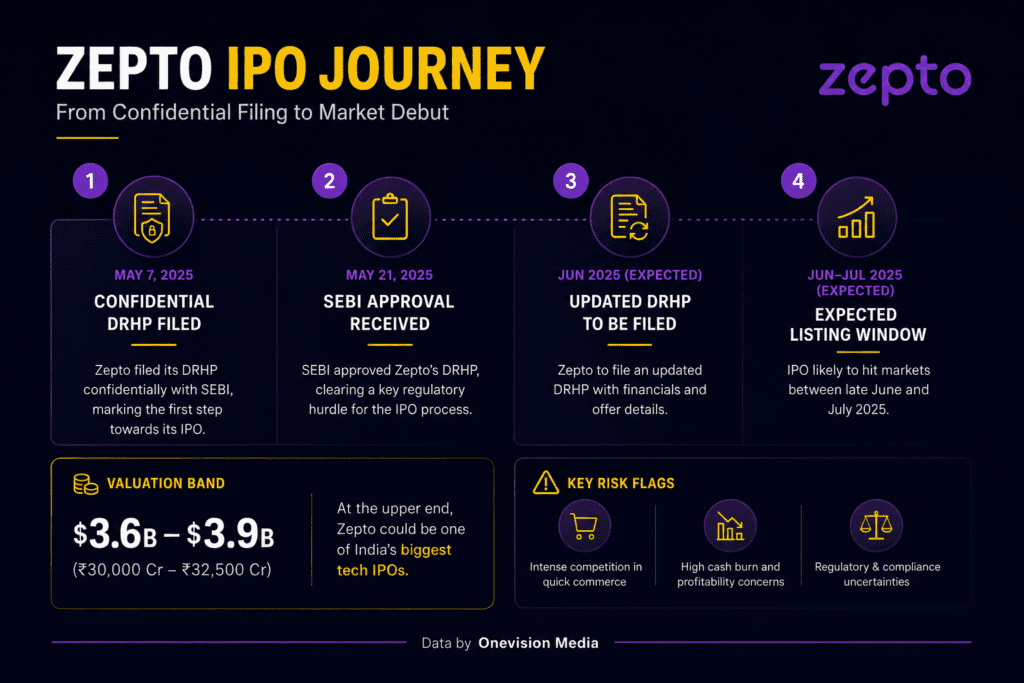
Zepto’s IPO story moved from rumor to process when reports said the company secured SEBI approval and would now work on an updated DRHP. Reuters had already reported in late 2025 that Zepto had confidentially filed for an IPO, which set the stage for the current round of approval chatter. The market read is simple: the paperwork is advancing, but the exact Zepto IPO date is still not locked.
The most cited expectation in recent reporting is a listing window between June and September 2026, with some sources saying 60 to 90 days from the latest approval step. That makes “zepto ipo date today” a bad search term and an even worse investment thesis. For now, the only honest answer to “zepto ka ipo kab aayega” is: soon, but not officially announced.
Zepto IPO Details Investors Should Keep Eye On
The broad deal size being discussed ranges from $800 million to $1 billion, while other reports point to ₹10,000 crore to ₹12,000 crore, with a mix of fresh issue and offer-for-sale. Earlier coverage also suggested a valuation band around $5 billion to $7 billion, though that can move fast once bankers and markets start negotiating like adults in a tense WhatsApp group. The exact Zepto IPO expected price has not been officially disclosed, so any fixed-number claim is premature.
- A few structural points matter more than the headline size:
- A larger fresh issue can support growth and reduce burn pressure.
- A heavier OFS gives early investors partial exits, which the market usually notices.
- A lower valuation can improve post-listing sentiment, even if it looks less glamorous on paper.
Why this IPO is getting attention
Zepto is not just another startup trying to cash in on public-market appetite. It sits in the center of India’s quick-commerce battle, where speed, density, and customer habit are the product, not just groceries. That makes it both attractive and dangerous. Investors like the scale story, but they also know the business is capital hungry and hard to defend.
The company’s operating profile has also improved in recent reporting, with one source saying Zepto’s daily orders have climbed from roughly 1.5 to 1.7 million to more than 2.5 million. That kind of growth helps the pitch. Still, the central question is not whether people order from Zepto, it is whether the company can turn a high-frequency habit into durable economics, and not merely into a very expensive habit.
Zepto IPO analysis through unit economics
For more detailed understanding you can checkout our Zepto Business Case Study where we have deconstruct everything in detailed Zepto Case Study: The Business Model Behind 10-Minute Delivery in India
A dark-store model can scale quickly, but it also creates a fixed-cost structure that punishes weak density and sloppy inventory planning. In plain English, every extra store helps only if the store is busy enough to earn its keep.
For founders, the lesson is sharper than the stock market drama:
- Quick commerce rewards locality and repeat use.
- CAC alone is not the villain, but wasted repeatability is.
- If average order value stays low while fulfillment costs stay sticky, margins get squeezed fast.
Is Zepto IPO going to fail?
Not necessarily. But it could be a rough debut if the pricing is aggressive and the market decides Zepto is being sold as a growth miracle instead of a tough, operationally complex company. That is the real risk behind the search phrase “zepto ipo delay,” because delays often happen when companies and bankers try to rework the story around valuation, not around demand.
There are two possible outcomes:
- A clean listing, if the issue is priced conservatively and investors believe the path to scale is credible.
- A weak first-day reaction, if the valuation assumes perfection while the business still looks like it is carrying a backpack full of subsidies.
The good news is that market appetite for startup listings in India is still alive. The bad news is that public markets do not reward narratives forever. They eventually ask for numbers, which is their annoying but useful hobby.
What can derail the deal – Several factors can pressure the Zepto IPO:
- Valuation mismatch between private-market expectations and public-market reality.
- Higher-than-expected losses or slower margin improvement.
- Regulatory or timeline shifts in the updated DRHP process.
- A broader risk-off mood in Indian markets.
A minor typo check for honesty: that is where founders often teh mistake of mistaking attention for conviction. Public investors are not buying hype, they are buying a future cash flow story that still needs to prove itself.
Evidence & Transparency
This article relies on current reporting from Reuters and multiple Indian market publications, including coverage of Zepto’s confidential filing, SEBI approval, and expected listing window. The business-model angle is supported by Onevision Media’s internal case-study reference on Zepto’s dark-store economics, which is useful for context but not a substitute for regulatory filing data. For verification, the key sources used here were Reuters coverage, SEBI-related reporting, and the company-analysis case study linked above.
Methodology & References
To verify this piece, I cross-checked:
- Reuters reporting on Zepto’s IPO filing.
- Latest market-news coverage on SEBI approval and issue size.
- Earlier IPO timeline reporting and DRHP references.
- Onevision Media’s own case-study material on Zepto’s business model and unit economics.
Frequently Asked Questions
How can I invest in the latest IPO of Zepto in India?
To invest in the Zepto IPO, you will need an active demat and trading account with a SEBI-registered broker. Once the IPO opens for subscription, you can apply through your banking app using ASBA (Application Supported by Blocked Amount) or via your broker’s platform using UPI to block the necessary funds.
What are the key details of the recent IPO for Zepto?
Zepto received SEBI approval (observations) in May 2026 for its initial public offering, which aims to raise approximately ₹11,000 crore. The issue is expected to be a combination of a fresh issue of shares to fund expansion and an Offer for Sale (OFS) from existing investors, valuing the company between $7 billion and $8 billion.
What was the IPO price range for the rapid grocery platform Zepto?
As of May 2026, the official price range for the Zepto IPO has not yet been announced. The price band is typically finalized and disclosed only a few days before the IPO opens for public subscription, following the filing of the Red Herring Prospectus (RHP).
What is the Zepto IPO expected date in India?
While no specific launch date has been confirmed, Zepto is targeting a listing window in the July–September 2026 quarter (Q2 FY27). The company is expected to file its updated public documents within the next 6 to 8 weeks following its recent regulatory clearance from SEBI.






Zepto IPO looks promising