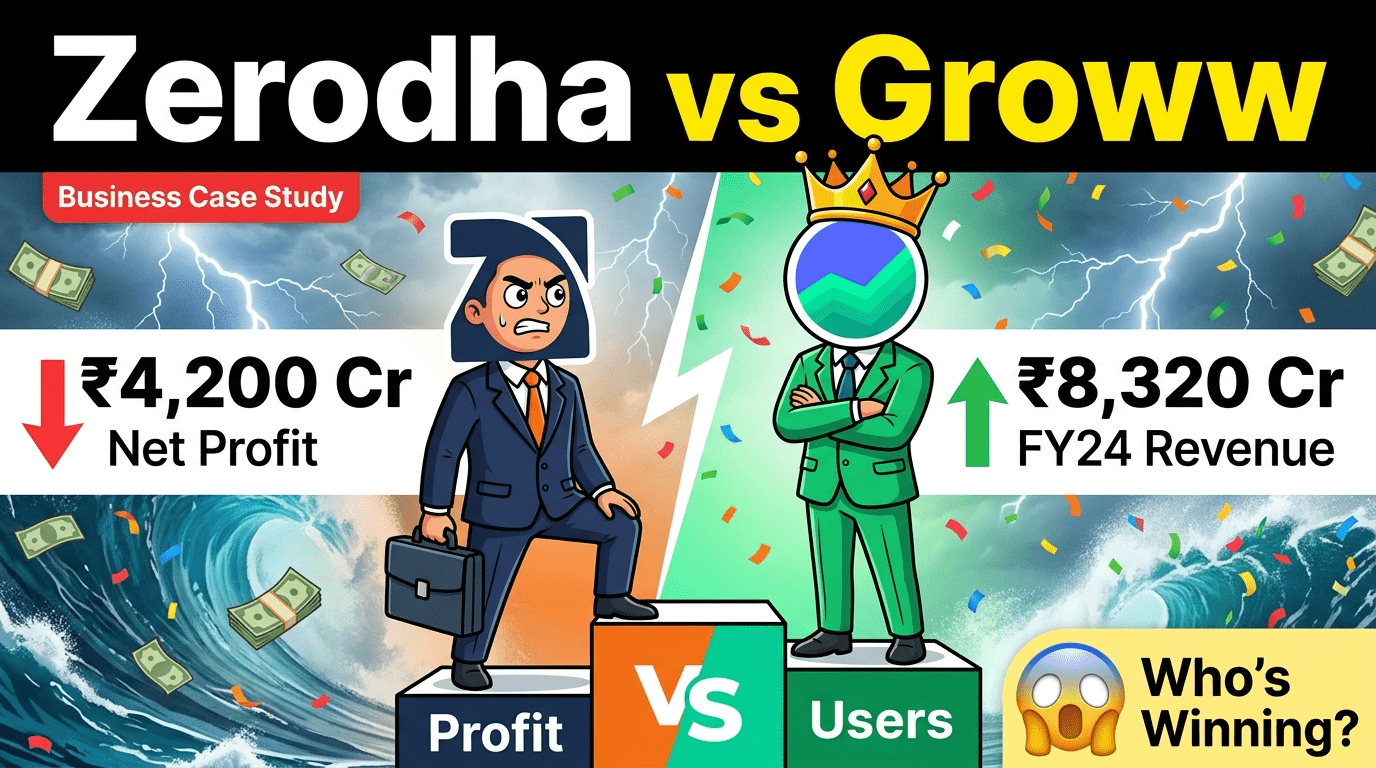
For a decade, Zerodha was untouchable. It built India’s most profitable brokerage from zero — no investors, no ads, no debt — and earned ₹4,700 crore in profit in FY24. Then three things happened at once. SEBI dismantled the F&O trading ecosystem that powered its revenue. Groww overtook it in active users with a 26.3% market share versus Zerodha’s 15.6%. And revenue fell 11.5% in FY25 — the first decline in company history. This Zerodha case study examines how a bootstrapped king loses its crown, and whether it can win it back.
Regulation will reduce business, markets could go down, and competition will increase. A perfect storm for us.” — Nithin Kamath, Co-founder & CEO, Zerodha
Zerodha by the Numbers: Proprietary Data Breakdown
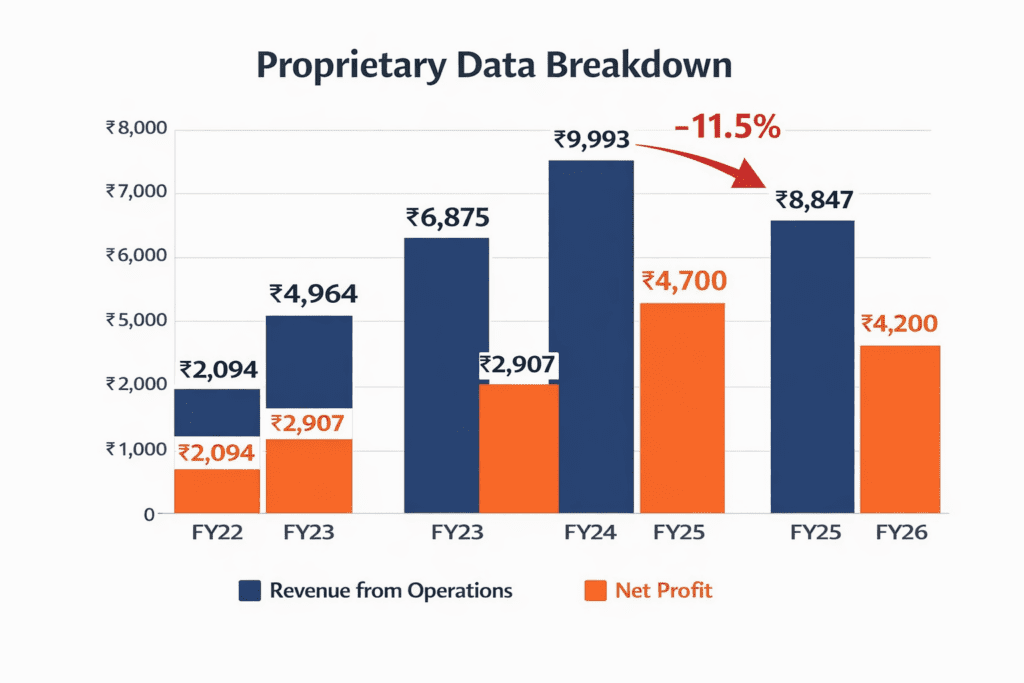
Zerodha Financial Performance: FY22 to FY25
| Metric | FY22 | FY23 | FY24 | FY25 |
| Revenue from Operations | ₹4,964 Cr | ₹6,875 Cr | ₹9,993 Cr | ₹8,847 Cr |
| Net Profit (PAT) | ₹2,094 Cr | ₹2,907 Cr | ₹4,700 Cr | ₹4,200 Cr |
| YoY Revenue Growth | — | +38.5% | +45.3% | -11.5% |
| Cash & Reserves | — | — | — | ₹22,679 Cr |
| Active Clients (NSE) | ~5.5M | ~6.8M | ~8.1M | ~7.2M |
| Market Share (Active NSE) | ~18% | ~17% | ~16.25% | ~15.6% |
Sources: RoC filings, NSE data, Zerodha blog disclosures, Entrackr (November 2025).
The profit number is real and it is impressive. But it is masking a structural deterioration that every founder and entrepreneur in India should study closely. Revenue fell ₹1,146 crore year-on-year in FY25 — the first contraction in fourteen years of operation. Active client count slid from a peak of ~8.1 million to ~7.2 million. Market share has declined for three consecutive years. Zerodha is still the most profitable broker in India by a wide margin, but it is earning that profit from a base that is quietly shrinking, not growing.
Zerodha vs Groww vs Angel One vs Upstox: Platform Comparison (2025–26)
| Parameter | Zerodha | Groww | Angel One | Upstox |
| Active NSE Clients (Oct 2025) | ~7.1M | ~11.9M | ~6.9M | ~2.3M |
| Active Client Market Share | 15.6% | 26.3% | 15.2% | 5% |
| Net Profit FY25 | ₹4,200 Cr | ₹1,824 Cr | ~₹900 Cr | ~₹200 Cr |
| Equity Delivery Brokerage | ₹0 | ₹0 | ₹0 | ₹20 or 2.5% |
| Intraday / F&O Brokerage | ₹20/order | ₹20/order | ₹20/order | ₹20/order |
| Demat AMC (Annual) | ₹300 | ₹0 | ₹240 | ₹300 |
| DP Charges (per sell) | ₹13.5 | ₹20 | ₹20 | ₹20 |
| Funding Model | Bootstrapped | VC-backed | Listed | VC-backed |
| Mutual Fund Platform | Coin (₹0 commission) | In-app | In-app | In-app |
| Primary User Profile | Active trader | First-time investor | Mid-segment | Tier 2/3 city |
Sources: NSE data, Nuvama Institutional Equities (October 2025), company disclosures, broker comparison platforms (FY25–26).
The brokerage charge comparison reveals something important: the four major platforms are now virtually identical on price. All charge ₹20 per intraday and F&O order. All offer free equity delivery. When price is equal across competitors, the battle shifts entirely to user experience, ecosystem depth, and brand trust — and that is a very different war from the one Zerodha originally won.
Zerodha vs Groww: Two Different Bets on India’s Financial Future
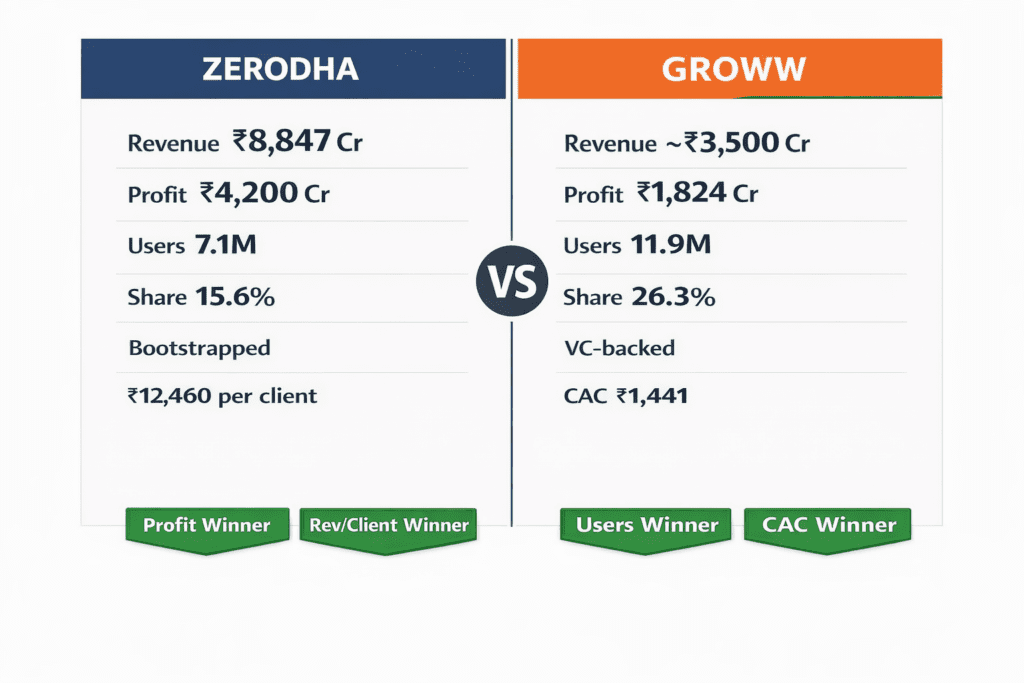
On the surface, Zerodha and Groww look like direct competitors. They charge the same ₹20 per intraday and F&O order, operate in the same SEBI-regulated market, and both built their businesses by killing the traditional full-service broker. But underneath the surface, they are running fundamentally different businesses — and the gap between their strategies explains almost everything about where each company is headed.
The Financial Picture: Who Is Actually Winning?
| Metric | Zerodha | Groww |
| Revenue FY25 | ₹8,847 Cr | ~₹3,500 Cr (est.) |
| Net Profit FY25 | ₹4,200 Cr | ₹1,824 Cr |
| Profit Margin FY25 | ~47% | ~52% (est.) |
| Active NSE Clients (Oct 2025) | 7.1M | 11.9M |
| Active Client Market Share | 15.6% | 26.3% |
| Revenue per Active Client (est.) | ~₹12,460 | ~₹2,940 |
| Cash Reserves | ₹22,679 Cr | Not disclosed |
| Funding Model | Bootstrapped | VC-backed (Tiger Global, Sequoia) |
| IPO Status | No plans announced | Targeting $6–8B valuation |
| Customer Acquisition Cost (FY25) | Higher (organic only) | ₹1,441 per active client |
The number that defines this entire rivalry is revenue per active client. Zerodha generates an estimated ₹12,460 per active client annually versus Groww’s approximately ₹2,940. Zerodha’s users trade more, hold more complex instruments, and generate significantly higher brokerage per head. Groww’s users are more numerous but lighter in trading activity — skewing toward SIPs and long-term equity holdings that generate minimal brokerage per transaction.
This is not a flaw in Groww’s model. It is the model. Groww is playing a volume and lifetime value game: acquire users cheaply at ₹1,441 CAC, convert them from passive savers into active investors over time, and monetise through lending, insurance distribution, and eventually asset management. Zerodha is playing a depth game: serve fewer, higher-value users with a richer ecosystem and extract more revenue per relationship.
Business Model: Depth vs Scale
Zerodha’s business model was built around the Indian active trader the person who checks Kite every morning, runs F&O strategies, uses GTT orders, and accesses the Kite API for algorithmic execution. Every product in the ecosystem Sensibull for options analytics, Streak for no-code algo trading, Coin for direct MFs, Varsity for education is designed to serve that user more deeply and reduce churn. The business earns when markets are active and traders are engaged.
Groww’s business model was built around the Indian first-time investor — the person who downloads the app because a friend mentioned SIPs, buys ₹500 worth of a Nifty 50 index fund, and gradually adds stocks over time. The interface is deliberately simple. There are no advanced charting tools, no options analytics, no API. Groww earns less per user upfront but bets on converting a mass user base into a full financial services relationship over a 5–10 year horizon — adding lending, insurance, credit cards, and wealth management as the user matures.
The SEBI F&O crackdown of 2024–25 hit these two models very differently. Zerodha lost its highest-revenue cohort — the aggressive F&O retail trader — directly to regulatory restriction. Groww’s core cohort was barely touched — equity delivery and SIP investors were unaffected by derivative regulations. Nuvama Institutional Equities estimated that a 5% drop in F&O orders would drag Groww’s revenue by only 2.5% versus a far steeper impact on Zerodha and Angel One. Groww was structurally insulated from the exact regulatory risk that Zerodha was fully exposed to.
The uncomfortable truth of this rivalry is that Zerodha built the superior product and Groww built the superior distribution. In Indian consumer markets, distribution has historically won. But Zerodha’s ₹22,679 crore war chest and 47% profit margin mean it has the financial resilience to outlast almost any competitive pressure — if it can diversify its revenue fast enough to stay relevant to the next generation of Indian investors.
Technical Deconstruction: Why the Crown Slipped
Pillar One — The Bootstrapped Moat That Made Zerodha Untouchable
Nithin Kamath and Nikhil Kamath launched Zerodha in 2010 with one radical idea: charge a flat ₹20 per trade instead of a percentage of trade value. In a market where full-service brokers charged 0.5–1% per trade — meaning a ₹10 lakh trade cost ₹5,000–₹10,000 — Zerodha’s flat fee was a market shock. The company grew entirely on word-of-mouth and financial creator networks, never raising a single rupee of external capital.
This bootstrapped model became Zerodha’s most durable competitive advantage for a reason most analysts understate: no investor pressure means no pressure to sacrifice profitability for growth. Groww has raised hundreds of millions of dollars from Tiger Global and Sequoia — capital that comes with growth targets and valuation pressure. Zerodha has never had those conversations, and that freedom produced extraordinary unit economics.
In FY25, with revenue of ₹8,847 crore and net profit of ₹4,200 crore, Zerodha’s profit margin sat near 47% — almost unheard of in fintech globally. Its ₹22,679 crore cash reserve makes it one of the best-capitalised non-banking financial entities in India. In a prolonged market downturn, that war chest is the difference between survival and distress. No VC-backed competitor can match that buffer.
Pillar Two — The F&O Revenue Machine SEBI Switched Off
Zerodha’s structural vulnerability was always visible to those paying close attention: a disproportionate dependence on derivatives trading. The F&O segment powered the lion’s share of brokerage income, driven by millions of retail traders executing short-expiry options on weekly Nifty and Bank Nifty cycles. SEBI’s regulatory overhaul between 2024 and 2025 systematically dismantled every condition that made this possible.
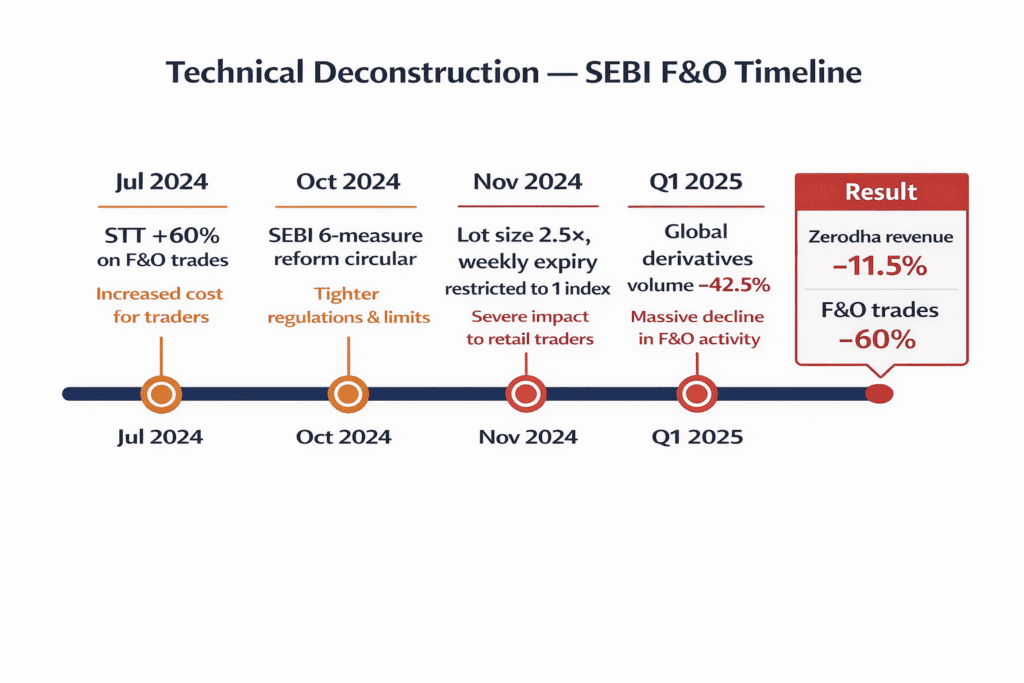
STT Hike (July 2024): Securities Transaction Tax on F&O trades was raised by approximately 60% — futures sell turnover tax rose from ₹625 to ₹1,000 per crore and options sell turnover jumped from ₹3,125 to ₹5,000 per crore. This raised the cost of every trade for every retail participant overnight.
Weekly Expiry Limits (November 2024): SEBI restricted weekly options expiries to just one benchmark index per exchange — effectively only Nifty on NSE and Sensex on BSE. Bank Nifty, Nifty Financial Services, Nifty Midcap Select, and Nifty Next 50 weekly contracts were discontinued, eliminating the near-daily expiry cycle that had fuelled massive retail volumes.
Lot Size Doubling (November 2024): Minimum contract sizes were raised from the ₹5–10 lakh range to ₹15–20 lakh, filtering out the large segment of undercapitalised retail traders who had driven volume growth.
Nithin Kamath publicly estimated in October 2024 that these measures would hit approximately 60% of overall F&O trades and ~30% of total Zerodha orders. The Futures Industry Association confirmed the scale — global exchange-traded derivatives volume fell 42.5% in Q1 2025, driven largely by India’s regulatory crackdown. Retail F&O participation declined 20% comparing January–February 2025 against the April–October 2024 average. A SEBI study had already established that 93% of retail F&O traders lose money — the regulatory intent was investor protection, but the business consequence for volume-dependent brokers was severe.
Pillar Three — The Invisible Variable: Who Owns the Next Indian Investor
The most dangerous competitive threat Zerodha faces is not the regulation SEBI already passed — it is the demographic shift happening beneath the market data. India’s next wave of retail investors is not coming from the active trader community. They are coming from Tier 2 and Tier 3 cities, from college campuses, from families making their first SIP on a smartphone. These users do not know what GTT orders are. They will never use the Kite API. They downloaded Groww because a friend sent them a referral link.
Groww’s ₹1,441 Customer Acquisition Cost is a signal of something deeper than marketing efficiency — it reflects the fact that Groww has embedded itself into the cultural moment of India’s first-time investment wave. By the time these users graduate into more sophisticated financial products — margin trading, F&O, direct equity research — Groww will already be their default financial home. Switching costs will make Zerodha increasingly difficult to reach.
Zerodha’s ecosystem — Kite, Coin, Varsity, Sensibull, Streak — is genuinely world-class. But it is optimised for a user who already understands why it is better. The next 100 million Indian investors do not yet know enough to make that comparison. Groww meets them where they are. Zerodha waits for them to arrive. In a market growing this fast, waiting is a strategy with a cost.
Implementation Framework: How Zerodha Is Fighting Back
Zerodha has responded to the triple pressure of regulation, competition, and revenue decline with a structured diversification strategy. Here is the exact playbook it has deployed — and the logic behind each move.
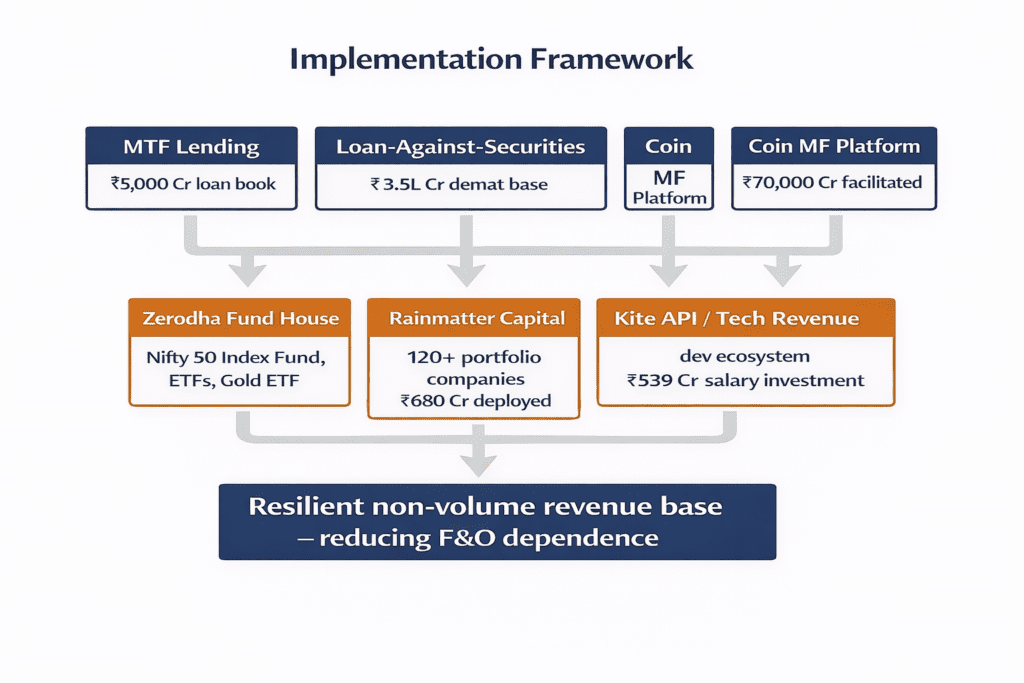
Step 1 — Margin Trading Facility (MTF) Expansion. Zerodha’s MTF loan book grew to ₹5,000 crore by late 2025, providing recurring interest income entirely independent of F&O trade volumes. This is the most immediate structural shift — moving from transaction revenue to lending spread revenue.
Step 2 — Loan-Against-Securities (LAS). By leveraging the ₹3.5 lakh crore worth of customer assets held in its demat accounts, Zerodha has expanded LAS services — earning spread income on pledged portfolios without requiring new customer acquisition. The existing base becomes the product.
Step 3 — Coin by Zerodha: Zero Commission, Maximum Retention. Coin has facilitated over ₹70,000 crore in total mutual fund investments across 2,200+ schemes from 41 AMCs at zero commission. The platform’s strategic value is not the direct revenue it generates — it is the retention and wallet-share deepening it creates among existing users. Key features include SIP automation via eNach, Systematic Transfer Plans, Systematic Withdrawal Plans, unified demat view of stocks and MFs, and comprehensive tax-ready reporting.
| Feature | Pros | Cons |
| Commission | ₹0 — direct plans only | Requires Zerodha demat (₹300 AMC) |
| Fund access | 2,200+ schemes, 41 AMCs | App UX reported as inconsistent |
| Portfolio view | Unified: stocks + MFs in one demat | Locked into Zerodha ecosystem |
| SIP tools | eNach, step-up SIP, SWP, STP | No advisory or recommendation engine |
| Tax reporting | Comprehensive, download-ready | NAV update delays reported by some users |
Step 4 — Zerodha Fund House: Building the AMC. Zerodha’s own asset management company launched the Zerodha Nifty 50 Index Fund in September 2025, followed by the Nifty 100 ETF (TOP100CASE), Nifty Midcap 150 ETF (MID150CASE), and Gold ETF (GOLDCASE). A passive-only fund suite generates recurring management fee income — structurally different from, and more stable than, brokerage revenue.
Step 5 — Rainmatter Capital: The Ecosystem Flywheel. Zerodha’s venture arm has deployed over ₹680 crore across 120+ companies in fintech and financial education — Smallcase, Streak, Sensibull, Quicko, and others. Portfolio company tools are embedded directly into the Zerodha platform, increasing product stickiness without additional R&D spend. It is a flywheel: Zerodha funds companies that make Zerodha better.
Step 6 — Technology Investment and Pricing Review. FY25 salary costs rose 31% to ₹539 crore, reflecting aggressive engineering hiring. The Kite Connect API generates independent software services revenue from algorithmic traders and fintech developers. Nithin Kamath has publicly signalled a pricing structure review — a likely move toward subscription or tiered pricing that creates predictable monthly revenue independent of market conditions.
Forecast & Strategic Outlook: Can Zerodha Win Back the Crown?
The next 24 months will determine whether Zerodha’s diversification strategy executes fast enough to offset structural revenue loss — or whether the company settles into a highly profitable but permanently smaller role in India’s financial ecosystem.
Revenue stabilisation, not recovery, is the realistic FY26 scenario. The F&O regulatory changes are now fully embedded into market structure. Traders have adapted, volumes have adjusted, and the speculative retail fringe has largely exited the market. Zerodha’s revenue is unlikely to return to its FY24 peak of ~₹10,000 crore in the near term. A ₹7,000–₹8,500 crore range in FY26 is the most probable outcome, contingent on market conditions and the pace at which MTF and Fund House revenues scale.
Coin and Zerodha Fund House graduate from ancillary to core. India’s SIP inflows have remained resilient throughout the F&O volume decline. As passive investing penetration deepens — driven by AMFI’s investor education campaigns and the mainstreaming of index funds — Zerodha Fund House’s ETF suite is positioned to capture growing retail AUM and generate recurring management fee income that brokerage revenue never could provide.
The user gap with Groww will widen before it narrows. Groww is targeting an IPO at a valuation of $6–8 billion. Post-listing capital will fund accelerated user acquisition, lending expansion, and entry into asset management at scale — directly threatening Coin and Zerodha Fund House on Zerodha’s own turf. Without external capital, Zerodha cannot match that velocity. The active client gap — currently 11.9 million versus 7.1 million — will likely stretch to 2x–3x by FY27.
Profitability remains the most underrated weapon in this fight. In a prolonged market downturn — the kind that forces VC-backed companies to cut costs, delay IPOs, and renegotiate valuations — Zerodha’s ₹22,679 crore cash reserve and ~47% profit margin give it survival capacity that no competitor can match. If Groww faces post-IPO pressure to justify its valuation during a bear cycle, Zerodha’s balance sheet becomes its most powerful strategic asset.
SEBI’s regulatory tightening is a multi-year trend, not a one-time event. Additional measures on open interest calculation, position limits, and algorithmic trading are already in the pipeline for FY26. Every tightening measure disproportionately harms volume-dependent revenue. Zerodha is the only major broker investing in diversification from a position of genuine financial strength — which means it is better placed than any competitor to absorb further regulatory shocks.
The verdict for 2027: Zerodha will remain India’s most profitable brokerage. It will not reclaim the user crown from Groww. The defining question is not survival — it is relevance. Can Zerodha build the wealth management, lending, and passive investing businesses fast enough to be the platform that India’s growing middle class chooses for long-term financial life, not just active trading? That answer will determine whether this case study ends as a comeback story or a cautionary tale about a company that was built perfectly for a market that regulators decided to change.
Methodology & References
This article draws on the following primary and secondary sources, cross-referenced for accuracy as of April 2026.
Financial data: Zerodha consolidated financial statements sourced from the Registrar of Companies (RoC), reported by Entrackr (November 2025) and YourStory (September 2024). Zerodha FY24 blog disclosure by Nithin Kamath on zerodha.com (September 24, 2024).
Market share data: National Stock Exchange (NSE) active client data as reported by Storyboard18 (March 2025), Entrackr (January 2026), and Startuppedia (November 2025). Nuvama Institutional Equities research note on Groww (October 29, 2025) via BusinessToday.
Regulatory data: SEBI circular on index derivatives framework (October 1, 2024). Zerodha Z-Connect blog on SEBI F&O rules (December 2024). Wright Research F&O analysis (October 2025). Jefferies analyst note via Business Standard (July 2024).
Coin and Zerodha Fund House: Zerodha Coin App Store listing, Zerodha support portal, Tickertape Mutual Fund Screener (January 2026), Zerodha Fund House official website.
Competitive charges data: Moniwise.in, MyJar App Blog, ChittorGarh, InvestorGain (2025–26), cross-checked against official broker charge pages.
Search methodology: All data verified between March–April 2026. Rupee figures cited in originally reported form. Percentages independently calculated where not directly disclosed.
Frequently Asked Questions
Q: What is the Zerodha case study about and why does it matter to Indian founders and entrepreneurs?
A: The Zerodha case study is the story of how a bootstrapped Bangalore startup disrupted India’s stock brokerage industry by introducing flat-fee pricing and technology-first infrastructure — then faced its first major existential test from regulatory change and competitive disruption simultaneously. Founded by Nithin and Nikhil Kamath in 2010, Zerodha earned ₹4,200 crore net profit in FY25 while sitting on ₹22,679 crore in cash, entirely without external funding. For Indian founders, it is both an inspiration and a warning: a model of profitability-first growth being stress-tested by forces outside its control.
Q: How did Zerodha lose its number one position in active clients to Groww?
A: Zerodha lost its top position in active clients because Groww built a product optimised for India’s first-time investor — simpler, more mobile-friendly, and aggressively distributed — while Zerodha stayed focused on its core active trader base. Groww’s ₹1,441 Customer Acquisition Cost in FY25 allowed it to scale user numbers at a pace Zerodha’s organic-only, bootstrapped model could not match. By October 2025, Groww held 26.3% active client market share versus Zerodha’s 15.6%, with 11.9 million clients versus Zerodha’s 7.1 million. The gap continues to widen.
Q: How does Zerodha make money if it charges zero brokerage on equity delivery trades?
A: Zerodha generates revenue from ₹20 per executed order on intraday and F&O trades, ₹300 annual Demat AMC, ₹13.5 DP charges per sell transaction, interest income from its ₹5,000 crore MTF loan book, Kite API software services fees, and investment management fees through Zerodha Fund House. Equity delivery brokerage is free as a customer acquisition and retention strategy — the revenue comes from the trading, lending, and platform services built around that free entry point.
Q: What is Coin by Zerodha and is it worth using for mutual fund investment in India?
A: Coin by Zerodha is India’s largest zero-commission direct mutual fund platform, having facilitated over ₹70,000 crore in investments with access to 2,200+ schemes from 41 AMCs. It is worth using for investors already on Zerodha — it offers a unified demat view of stocks and mutual funds, SIP automation, STP, SWP, and tax-ready reporting, with no distributor commission built in. Direct plans via Coin can improve annual XIRR by 0.5–1.0% versus regular plans. The key limitation is that access requires an active Zerodha demat account with a ₹300 annual AMC.
Q: What exactly did SEBI’s F&O regulations in 2024–25 do to Zerodha’s business?
A: SEBI’s F&O overhaul hit Zerodha through three compounding blows. First, STT on F&O trades was raised by approximately 60%, increasing the cost of every retail trade. Second, weekly expiry contracts were restricted to one index per exchange, eliminating the near-daily expiry cycle that drove Zerodha’s highest-volume trading days. Third, minimum lot sizes doubled from ₹5–10 lakh to ₹15–20 lakh, pushing undercapitalised traders out of the market entirely. Nithin Kamath estimated the collective impact would hit ~60% of F&O trades. Revenue fell 11.5% in FY25 — the company’s first annual decline.
Q: Is Zerodha still safe to use given that it is not listed on a stock exchange?
A: Zerodha is among the safest retail brokerage platforms in India precisely because it carries no external debt and faces no investor pressure. Client funds are held in SEBI-regulated CDSL and NSDL depository accounts, ring-fenced from Zerodha’s own financials. Its ₹22,679 crore cash reserve and ~47% net profit margin in FY25 make it one of the most financially robust entities in Indian financial services. The absence of a stock market listing reduces public disclosure, but RoC filings confirm the financial health independently.
Q: What is the difference between Zerodha and Groww — which should a first-time Indian investor choose in 2025?
A: Zerodha is built for active traders and power users who want advanced charting, F&O access, API connectivity, and a deep ecosystem including Coin, Varsity, and Sensibull. Groww is built for first-time investors wanting a clean, simple, mobile-first experience for SIPs and direct equity. As of 2025, Groww leads in active users at 26.3% market share versus Zerodha’s 15.6%. First-time investors benefit most from Groww’s simplicity and zero AMC. Investors who want ecosystem depth, lower DP charges (₹13.5 vs ₹20), and access to direct MFs via Coin get more from Zerodha.
Q: What is Zerodha’s strategic outlook for 2026–2027 — can it come back?
A: Zerodha’s near-term revenue is likely to stabilise between ₹7,000–₹8,500 crore in FY26 as the F&O shock is absorbed and MTF, Coin, and Zerodha Fund House revenues scale. The platform is not at existential risk — its ₹22,679 crore cash reserve provides extraordinary resilience. However, it will not reclaim active user leadership from Groww in this period. The comeback story — if it happens — depends on whether Zerodha’s wealth management, lending, and passive investing businesses grow fast enough to attract the next wave of Indian investors, not just retain the existing trading cohort. Best investment platforms for Indian founders 2026