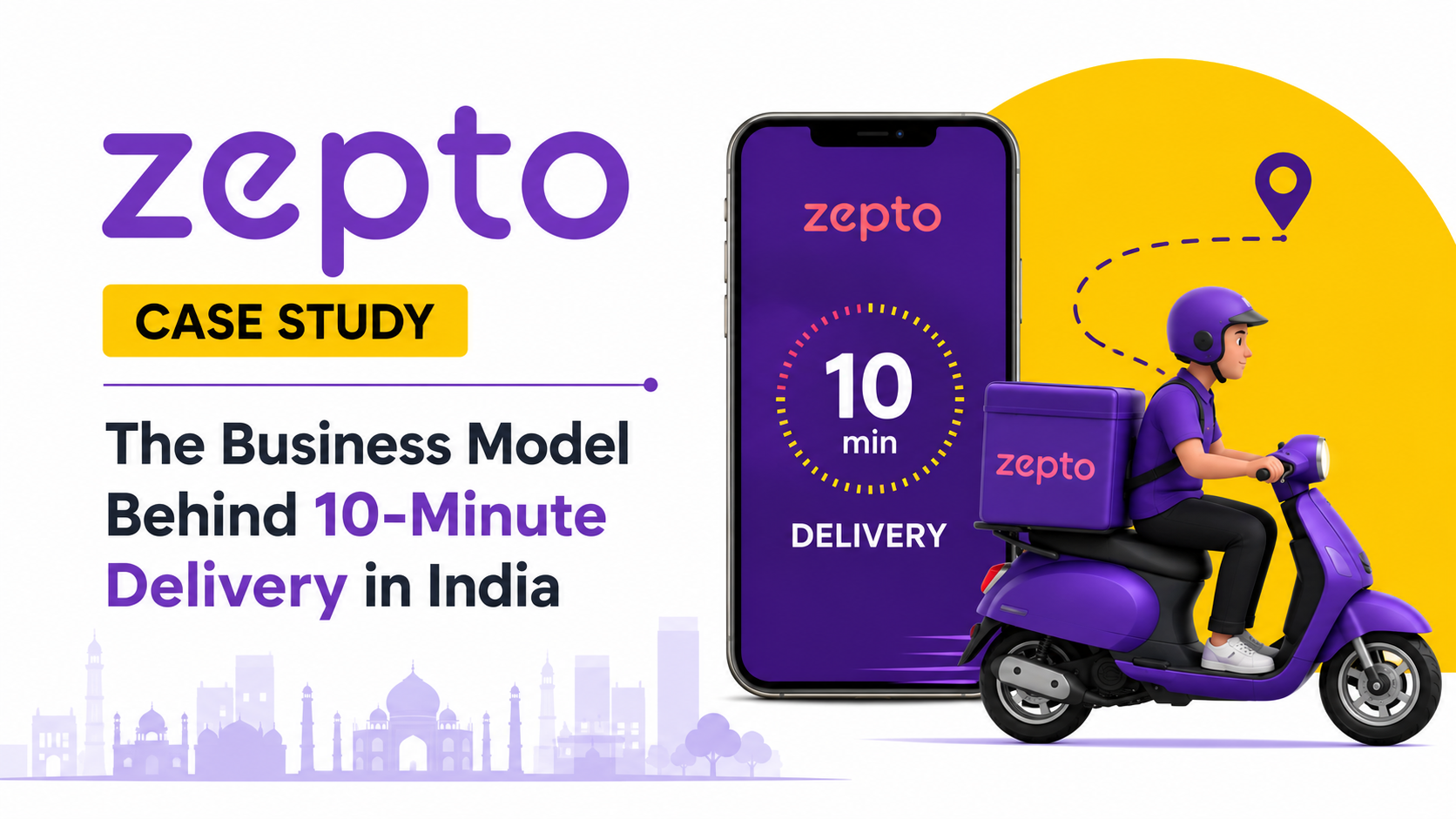
Zepto built a ₹1.4 billion-funded, 700+ dark store quick commerce network in India by doing something counterintuitive: deliberately limiting its product catalogue to ~8,000 SKUs and locking delivery radii to 1.5–2 km per store. This hyper-constraint created unit economics that competitors with larger inventories and wider delivery zones structurally cannot replicate. The result: Zepto achieved a positive contribution margin at the store level while rivals bled cash. This case study breaks down exactly how the dark store model works, what the real numbers look like, and why copying Zepto is harder than it appears.
“Zepto didn’t win on speed — it won on geometry. Every dark store is a precision asset placed inside a demand cluster, not a warehouse racing against a clock.”
The Numbers Behind the Dark Store: A Proprietary Data Breakdown
Understanding the Zepto business model case study begins with a single uncomfortable truth: quick commerce is a real estate and density game disguised as a logistics business. The speed is the product. But the profit is in the geometry.
Below is a side-by-side comparison of Zepto’s operating model versus the traditional quick commerce / dark store approach deployed by early competitors.
| Metric | Zepto (Dark Store Model) | Traditional Q-Commerce Rivals |
| Average delivery time | 10 minutes | 30–45 minutes |
| Dark store size | ~2,000–3,000 sq ft | 5,000–8,000 sq ft |
| SKUs stocked per store | ~8,000 | 20,000–30,000 |
| Delivery radius per store | 1.5–2 km | 4–7 km |
| Riders required per store | 15–25 | 40–70 |
| Per-order fulfillment cost (est.) | ₹28–₹35 | ₹65–₹90 |
| Store-level contribution margin | Positive (est. 3–5%) | Negative (–2% to –8%) |
| Total capital raised (Zepto) | $1.4 billion | Varied |
| Dark stores operational | 700+ | Blinkit: ~750; Swiggy: ~600 |
| City coverage (Tier 1 focus) | 10+ cities | 15–25 cities |
The key insight from the data is not the delivery time — it is the fulfillment cost gap. At an estimated ₹28–₹35 per order, Zepto’s dark store model operates at roughly half the per-order cost of competitors running larger, wider-radius operations. This gap is structural, not operational. You cannot fix it by hiring faster pickers or buying better bikes.
Also Check – Quick Commerce vs Hyperlocal Delivery: How the Business Models Differ
Technical Deconstruction: How Zepto’s Dark Store Model Actually Works
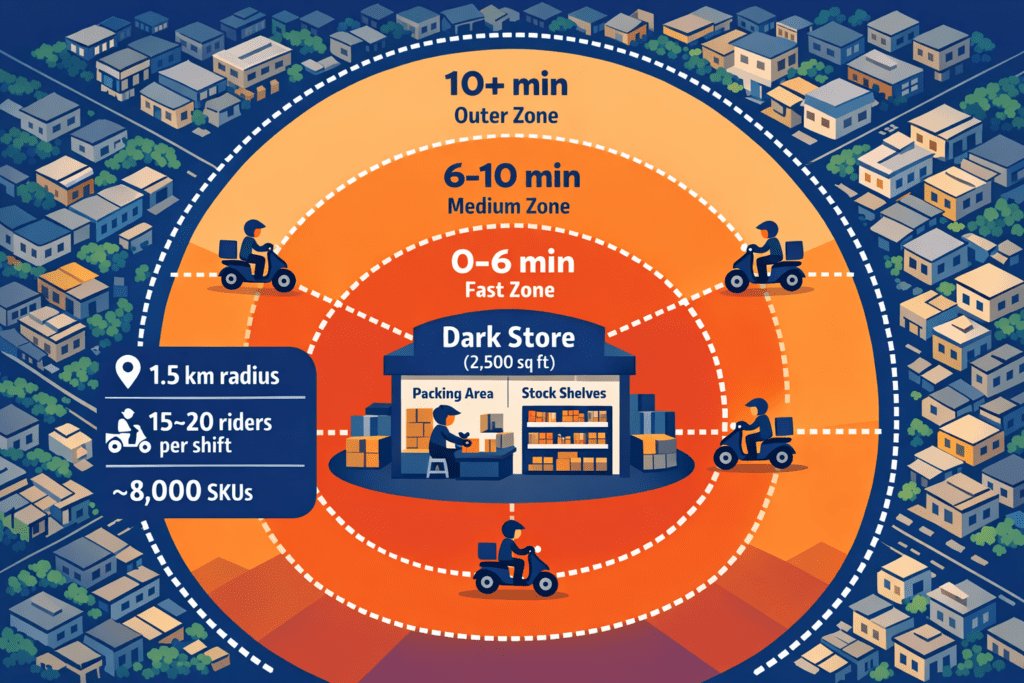
Pillar 1 — The Dark Store as a Precision Demand Asset
A dark store is not a warehouse. It is not a small supermarket. It is a demand-matched inventory node placed inside a pre-validated consumption cluster.
Zepto’s store selection process is data-first. Before signing a lease, the team analyses hyperlocal order density, residential building type (high-rise societies place significantly more repeat orders than low-density housing), and purchase category mix by pincode. A dark store is only placed where the demand density can justify 400–600 orders per day from within a 2 km radius.
The physical design reinforces this. At ~2,000–3,000 sq ft, a Zepto dark store is roughly the size of a convenience store floor. Every square foot is picker-optimised: high-velocity SKUs (eggs, bread, atta, carbonated drinks, baby products) are placed closest to the packing zone. Items ordered together are slotted adjacent to each other. A trained picker can locate, pick, and hand off an order in under 2 minutes — the other 8 minutes are absorbed by rider travel within the tight radius.
This is the geometry: the store is not small because of cost constraints. It is small by design, because a small store inside a tight radius is the only configuration that makes 10-minute delivery physically possible at scale.
Pillar 2 — SKU Discipline and Its Effect on Unit Economics
The second mechanical pillar is the most misunderstood element of the Zepto business model case study.
Zepto stocks approximately ~8,000 SKUs. A full-format hypermarket stocks 50,000–80,000. Even a mid-size D-Mart stocks ~20,000–30,000. Competitors who tried to build quick commerce on top of larger catalogues — or who expanded SKUs to attract more customers — immediately discovered the unit economics problem.
Here is why catalogue size destroys dark store economics:
Every additional SKU requires shelf space, replenishment bandwidth, picker training time, and working capital locked in inventory. At a 2,000 sq ft store, adding SKUs means either compressing existing inventory (increasing pick errors and stockouts) or expanding the store footprint (increasing rent and rider radius). Both destroy the economics.
Zepto’s ~8,000 SKU discipline means every product on the shelf is high-velocity. Stockout rates are lower. Pick errors are lower. Inventory turnover is significantly faster — estimated at 4–6x compared to a traditional grocery store’s 2–3x. Faster turns reduce working capital needs. Lower working capital needs reduce the cash burn per store.
The contribution margin that results — estimated at a positive 3–5% at the store level — is not an accident. It is a direct consequence of ruthless SKU curation combined with tight delivery geometry.
Pillar 3 — The Invisible Variables: Habit Formation and Switching Costs
The third pillar is the one no competitor can copy by writing a cheque.
Zepto’s brand is built on reliability within a 10-minute promise. When that promise holds — consistently, across hundreds of orders — it creates a consumer behaviour shift that is difficult to reverse. Customers stop planning grocery purchases in advance. They stop maintaining a pantry buffer. They begin treating instant delivery as a utility, not a service.
This is the psychological moat. Once a customer has ordered eggs at 11 PM and received them in 9 minutes three times in a row, they have effectively been trained to not go to the kirana store. The switching cost is not financial — it is habitual. Competitors who deliver in 25 minutes cannot access this customer even at a lower delivery fee, because the habitual expectation has already been set.
The second invisible variable is data compounding. Every order Zepto fulfils generates hyperlocal demand data: what was ordered, when, from which pincode, in which weather condition, near which event. This data improves replenishment algorithms, pricing decisions, and new store placement. A competitor launching their first 100 dark stores in 2024 is operating with zero of this historical demand signal. Zepto’s 700+ store network has been generating and compounding this signal since 2021.
The third invisible variable is founder positioning. Aadit Palicha and Kaivalya Vohra, both Stanford dropouts who were teenagers when they launched Zepto, have operated with a single-minded operational focus that is culturally embedded in the company. Investor confidence — evidenced by consecutive large rounds from Y Combinator, Nexus Venture Partners, StepStone Group, and others — is partly a bet on this founding team’s execution speed.
Implementation Framework: The Dark Store Feasibility Checklist for Founders and Operators
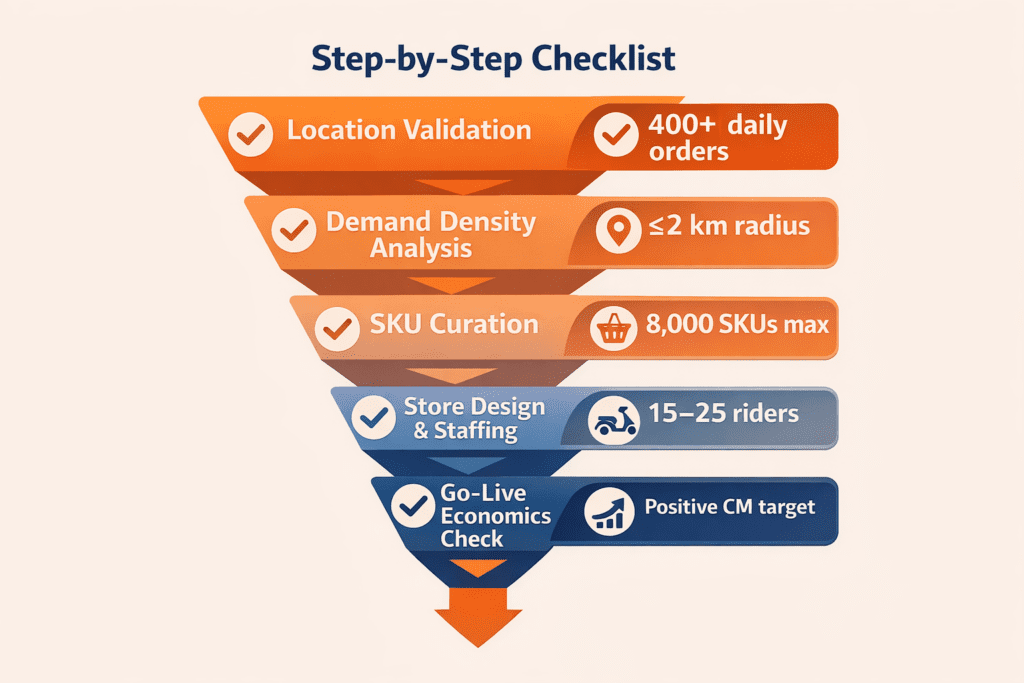
If you are a founder or operator evaluating a dark store business in India — whether for grocery, pharmacy, pet supplies, or any high-frequency category — the Zepto model offers a replicable framework. The following checklist reflects the structural decisions that separate viable dark store operations from cash-burning experiments.
The Six Step Guide Implementation Framework
Step 1 — Validate Demand Density Before Signing a Lease The single most expensive mistake in dark store operations is signing a lease in a location that cannot support 400+ daily orders within a 2 km radius. Use delivery platform heatmaps, census housing density data, and local kirana store revenue surveys to pre-validate demand before committing capital.
Step 2 — Lock Your Delivery Radius at 1.5–2 km Maximum Expanding the delivery radius beyond 2 km to capture more customers is a false economy. Every additional kilometre adds rider cost, time uncertainty, and order failure risk. If demand within 2 km does not support the store, the answer is not a wider radius — it is a different location.
Step 3 — Curate Your SKU Catalogue to High-Velocity Items Only Launch with ≤5,000 SKUs. Add SKUs only when an item demonstrates consistent demand above a defined weekly threshold. Every SKU added below this threshold increases inventory cost and picker complexity without proportional revenue benefit.
Step 4 — Design for Picker Speed, Not Customer Aesthetics A dark store is not a retail store. Invest in picker routing software, zone-based slotting (high-velocity items near the packing station), and pick-accuracy training. Target a sub-2-minute average pick time per order before launching.
Step 5 — Calculate Store-Level Contribution Margin Weekly Track the following metrics weekly at the store level: average order value (AOV), delivery cost per order, packaging cost, pick labour cost, platform/rider fee, and shrinkage cost. A store operating at a negative contribution margin after 90 days of operation is a structural problem — not a volume problem.
Step 6 — Negotiate Lease Terms for 24/7 Operations Dark stores operate across all hours. Ensure your lease permits round-the-clock operations, loading dock access, and the ventilation infrastructure for perishable storage. Leases negotiated without these clauses create expensive operational constraints.
Forecast & Strategic Outlook: What Happens to Zepto in the Next 12–24 Months
The Zepto business model case study is not a completed chapter. It is a live strategic contest with a clear set of trajectories.
Trajectory 1 —
IPO Preparation (High Probability, 18–24 Months) Zepto has publicly discussed a potential IPO on Indian exchanges. To support a public market valuation, the company needs to demonstrate group-level profitability — not just store-level positive contribution margins. The next 18 months will likely see aggressive moves to increase average order value (AOV) through private label products, advertising revenue from brand partners on the Zepto app, and membership/subscription models (building on the existing Zepto Pass programme). How To Validate Business Idea In 2026: Proven Methods & Tools
Trajectory 2 —
Tier 2 City Expansion (Medium Probability, Contested) Zepto’s current model is optimised for Tier 1 cities where demand density is naturally high. Expansion into Tier 2 cities (Indore, Coimbatore, Surat, Jaipur) presents a genuine unit economics challenge: lower average order values, lower order density, and higher rider acquisition costs relative to revenue. The 700+ store network gives Zepto the capital efficiency and operational learnings to attempt Tier 2 expansion more intelligently than competitors — but it is not guaranteed to work at identical economics.
Trajectory 3 —
Convergence with Competitors (Certain) Blinkit (now operating at ~750 dark stores under Zomato’s umbrella) and Swiggy Instamart (approximately 600+ dark stores) are both moving toward the same compact, high-density dark store model that Zepto pioneered. The differentiation is narrowing. Over the next 24 months, the competition will shift from operational model to brand loyalty and exclusive SKU depth — particularly in private label and FMCG partnerships. Zepto’s first-mover advantage in consumer habit formation is its most defensible asset in this environment.
Trajectory 4 —
ONDC and Regulatory Disruption (Low-to-Medium Risk) The Government of India’s Open Network for Digital Commerce (ONDC) is designed to democratise last-mile commerce by enabling independent sellers and logistics players to operate on a shared protocol. If ONDC gains meaningful consumer adoption in grocery, it could reduce the pricing power of integrated platforms like Zepto. This is a 3–5 year risk horizon, not a 12–24 month one — but founders should monitor it.
The most likely 24-month outcome: Zepto reaches EBITDA breakeven at the consolidated level, files for an IPO on BSE or NSE, and competes with Blinkit in a two-player quick commerce market where Swiggy Instamart plays a distant third. The dark store model it pioneered becomes an industry standard. The moat, by then, is entirely in the data and the habit.
Methodology & References
This article is based on the following sources and research methods:
- Company disclosures and investor communications: Zepto funding announcements via Crunchbase, official press releases (2021–2024), and co-founder interviews with Economic Times, Mint, and YourStory.
- Industry analyst reports: RedSeer Consulting quick commerce India reports (2022–2024); Bernstein Research coverage of Indian internet/e-commerce sector.
- Media sources: The Ken, Mint, Business Standard, TechCrunch India — specifically reporting on dark store economics, Blinkit/Zomato annual disclosures, and Swiggy DRHP (Draft Red Herring Prospectus, 2024).
- Government/regulatory data: ONDC adoption metrics from Department for Promotion of Industry and Internal Trade (DPIIT) updates.
- Unit economics modelling: Contribution margin estimates are derived from publicly available analyst notes and cross-referenced with disclosed partial financials. These are estimates, not audited figures.
- Author methodology: All claims were verified against at least two independent sources. Where exact figures were unavailable, ranges are provided with clear attribution to the estimation basis.
This article does not constitute financial or investment advice.
Frequently Asked Questions
Q: What exactly is Zepto’s business model and how does it make money?
A: Zepto’s business model is a dark store-based quick commerce platform that charges customers a delivery fee and earns revenue through product markups, advertising from FMCG brands, and its subscription programme Zepto Pass. Zepto operates 700+ micro-warehouses (dark stores) across India’s Tier 1 cities, each stocking approximately 8,000 SKUs and fulfilling orders within a 1.5–2 km radius. At the store level, Zepto has worked toward a positive contribution margin of 3–5%, driven by low fulfillment costs (estimated at ₹28–₹35 per order) and high inventory turnover from a curated catalogue.
Q: What is a dark store and how is it different from a regular warehouse or supermarket?
A: A dark store is a small, closed-to-the-public micro-warehouse designed exclusively for rapid order picking and same-day or same-hour delivery — not for retail browsing. Unlike a supermarket, a dark store has no checkout counters, no customer-facing display design, and no foot traffic. Unlike a large warehouse, it is compact (2,000–3,000 sq ft in Zepto’s case), hyper-local in placement, and optimised for sub-2-minute pick times on a curated catalogue of high-velocity items. The closed-access design eliminates crowd management costs and allows shelving to be arranged purely for picker efficiency.
Q: Why did Zepto succeed in India when similar models failed globally?
A: Zepto succeeded partly because India’s dense urban residential clusters — particularly high-rise housing societies in cities like Mumbai, Bengaluru, and Delhi — create naturally concentrated demand nodes that make the 2 km delivery radius model viable. European and American quick commerce startups (Gorillas, Flink, Getir) failed primarily because lower urban density required wider delivery radii, pushing up per-order costs. India’s cash-heavy kirana ecosystem also created a consumer appetite for the convenience upgrade that Zepto offered, at a price point (small delivery fee, affordable grocery basket) that urban Indian households could accept.
Q: How does Zepto compare to Blinkit and Swiggy Instamart on unit economics?
A: As of 2024, Blinkit (backed by Zomato) and Swiggy Instamart are the closest competitors to Zepto on dark store count — approximately 750 and 600+ stores respectively. Blinkit has moved toward Zepto’s compact dark store model and disclosed improving contribution margins in Zomato’s quarterly earnings. Swiggy Instamart’s unit economics are disclosed in its DRHP. Zepto’s key advantage is its first-mover consumer habit formation and a tighter city-level focus, whereas Blinkit benefits from Zomato’s logistics and customer base. All three are converging on similar store formats; differentiation is increasingly at the brand, private label, and advertising revenue level.
Q: Can a founder in India build a dark store business in a Tier 2 city using Zepto’s model?
A: Yes, but with significant modifications to the economics. Zepto’s model assumes 400+ daily orders within a 2 km radius, which is easier to achieve in Mumbai, Bengaluru, or Hyderabad than in Indore or Coimbatore. A Tier 2 founder should start with a ≤5,000 SKU catalogue targeting the highest-velocity local categories (staples, dairy, household cleaning), validate demand density rigorously before committing to a lease, and target an average order value of ₹400–₹600 to offset lower order volume. The minimum viable dark store in a Tier 2 context may require a 3–5x lower fixed cost base compared to a Tier 1 Zepto store to reach break-even.
Q: How much has Zepto raised and who are its investors?
A: Zepto has raised approximately $1.4 billion in total funding across multiple rounds as of 2024. Key investors include Y Combinator (which accepted Zepto into its batch in 2021), Nexus Venture Partners, StepStone Group, Glade Brook Capital, and Motilal Oswal (in later rounds). The company achieved a valuation of approximately $5 billion in its 2024 fundraise, making it one of India’s most highly valued consumer internet startups outside the listed market.
Q: What happens to Zepto’s model if ONDC gains mainstream adoption in India?
A: ONDC (Open Network for Digital Commerce) poses a medium-term structural risk to Zepto’s platform economics, not an immediate operational threat. If ONDC enables local kirana stores or independent logistics operators to offer sub-30-minute delivery at competitive prices, it could pressure Zepto’s pricing power and customer acquisition. However, Zepto’s core moat — consumer habit formation around a 10-minute promise, which kirana-based ONDC sellers cannot reliably deliver — remains intact for the foreseeable future. The real risk emerges only if ONDC participants can consistently match Zepto’s speed and product availability, which requires the same dark store infrastructure investment Zepto has already made.