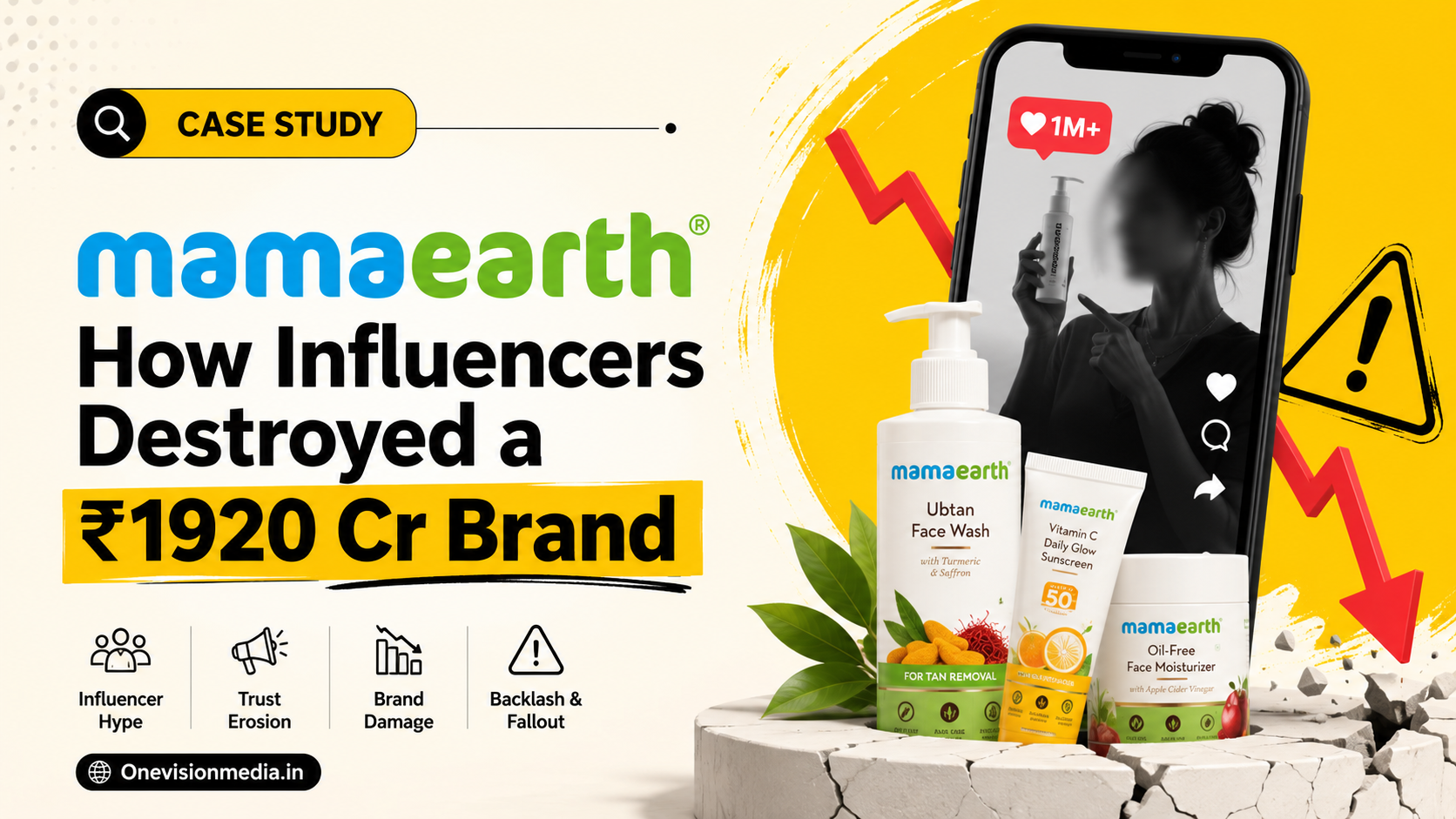
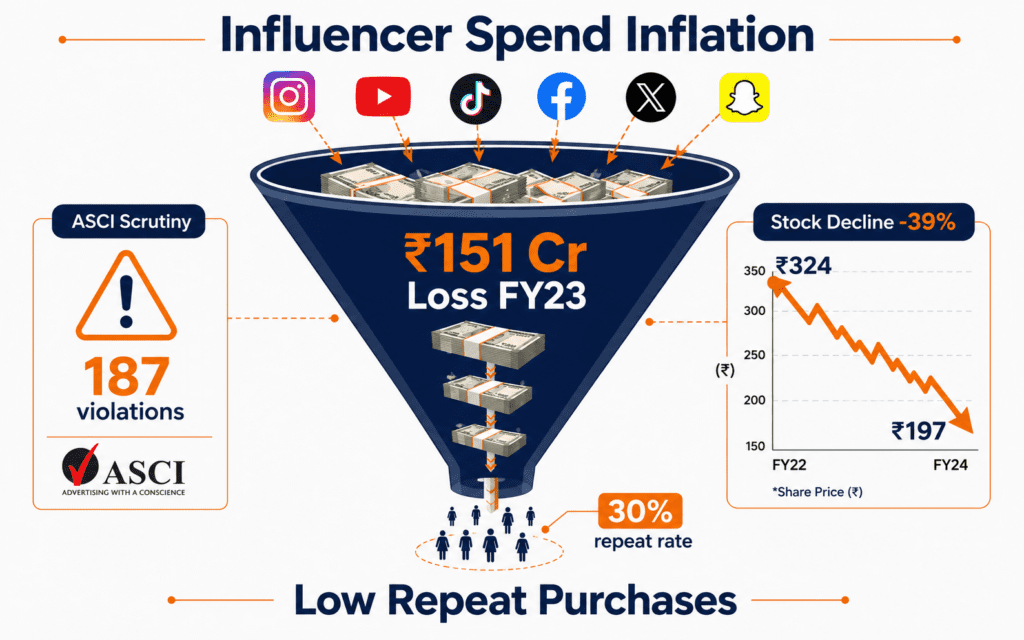
Honasa Consumer (Mamaearth) built India’s fastest-growing D2C beauty empire by spending heavily on influencer marketing, scaling from ₹459 crore in FY2021 to ₹1,920 crore in FY2024. But the same growth engine became a liability. The company faced 187 ASCI ad violations in a single year, 175 linked to influencer guideline breaches. Post-IPO stock performance tells the story: listed at ₹324 in November 2023, dropped to ₹197.51 within months, currently trading at ₹274.95, representing a 15% decline from issue price. The case demonstrates how paid advocacy at scale erodes organic brand equity faster than revenue can compensate.
Mamaearth Proprietary Data Breakdown –
Honasa Consumer’s financial trajectory reveals the core tension: explosive revenue growth paired with profitability volatility and mounting regulatory scrutiny.
| Metric | FY2021 | FY2022 | FY2023 | FY2024 | Change (FY21-24) |
| Revenue from Operations | ₹459 cr | ₹943 cr | ₹1,493 cr | ₹1,920 cr | +318% |
| Net Profit / (Loss) | (₹133.2 cr) | ₹14.4 cr | (₹151 cr) | ₹111 cr | Volatile |
| EBITDA Margin | N/A | N/A | Negative | 7.1% | Path to profitability |
| Online Channel % | 81.37% | 69.91% | 59.36% | ~64% | Declining dominance |
| ASCI Violations (Annual) | N/A | N/A | 115+ | 187 | +63% |
Stock Performance Post-IPO:
- Issue Price: ₹324 (Nov 7, 2023)
- 52-Week High: ₹334.20
- 52-Week Low: ₹197.51 (39% drop from issue price)
- Current Price: ₹274.95 (as of latest data)
- Market Cap Loss: ~₹721 crore from IPO valuation What the Numbers Reveal
The revenue trajectory looks impressive on the surface. 318% growth in three years puts Honasa in the upper tier of D2C success stories. But the profit line tells the real story. The company lost ₹133 crore in FY2021 while building brand awareness. Swung to a ₹14.4 crore profit in FY2022 as online sales peaked. Then immediately fell back into a ₹151 crore loss in FY2023 when offline expansion costs hit the books and marketing spend stayed elevated.
FY2024’s turnaround to ₹111 crore profit coincides with the IPO preparation phase. Companies clean up their unit economics before going public. The 7.1% EBITDA margin is respectable but thin for a consumer brand at this scale. For comparison, traditional FMCG players operate at 15-20% EBITDA margins once they reach mature scale.
The ASCI violation count is the hidden damage metric. 187 flagged ads in one year, with 175 of those failing influencer disclosure guidelines, signals systemic compliance failure. This isn’t one rogue campaign. It’s the business model itself generating regulatory friction.
A Technical Deconstruction of Mamaearth Profits, CAC, and Trust
Mamaearth Influencer First GTM Strategy (2016-2020)
Varun Alagh and Ghazal Alagh launched Mamaearth in 2016 with a clear thesis: win the millennial parent demographic by owning the Instagram feed. Traditional baby care brands like Johnson & Johnson were stuck in TV advertising and pharmacy distribution. Mamaearth went direct to consumer, pure online, with influencer partnerships as the primary customer acquisition channel.
The strategy worked spectacularly in phase one. Mommy bloggers and parenting influencers had built trusted audiences but lacked monetization options beyond occasional brand deals. Mamaearth offered structured long-term partnerships with attractive economics. The brand scaled from launch to ₹459 crore revenue by FY2021 entirely on the back of this playbook.
Online channels accounted for over 81% of revenue in the early years. Influencer content drove traffic to Mamaearth’s website and to marketplaces like Amazon and Nykaa where conversion rates were strong. Customer acquisition costs stayed manageable because the brand wasn’t competing in Google Ads or Facebook direct response channels where CPMs had already inflated.
Product innovation supported the GTM. The brand launched new SKUs rapidly, each designed to be “Instagram-friendly”: colorful packaging, ingredient call-outs that photograph well, and messaging hooks that translated cleanly into captions. The Onion Hair Oil became a breakout hero product because influencers could demonstrate visible results in before/after reels.
The Unit Economics Trap (2021-2023)
The model that worked at ₹500 crore scale started breaking at ₹1,500 crore scale. Several mechanical problems compounded simultaneously.
First, influencer costs inflated. Early adopters charged ₹10,000-50,000 per post. By 2022, the same creators were quoting ₹2-5 lakh for comparable deliverables. Macro influencers with 1M+ followers started demanding ₹10-20 lakh per campaign. The supply-demand economics shifted as every D2C brand in India adopted the same playbook. Honasa was now competing with Wow Skin Science, Plum, Minimalist, Sugar Cosmetics, and dozens of smaller entrants for the same creator inventory.
Second, customer lifetime value didn’t improve as cohorts matured. The brand assumed that customers acquired through influencer recommendations would develop organic loyalty and reorder without continued paid stimulus. Data showed otherwise. Repeat purchase rates remained below 30% after the first transaction. Without continued influencer visibility, customer churn accelerated. The brand had built awareness but not deep brand equity.
Third, offline expansion proved more expensive than modeled. Honasa opened retail partnerships and exclusive brand stores to capture the 40% of personal care purchases still happening in physical channels. But offline requires different unit economics: distributor margins, retail placement fees, demo costs, and inventory holding costs that don’t exist in pure D2C. Revenue per square foot in retail didn’t justify the occupancy costs, especially in Tier 2 cities where the brand tried to replicate its urban success.
The FY2023 loss of ₹151 crore reflects these three pressures hitting simultaneously. Marketing spend as a percentage of revenue stayed elevated, offline expansion burned cash, and the company couldn’t reduce influencer spend without immediately losing traffic and sales.
The Trust Deficit Variable
The ASCI violations reveal a deeper problem than simple non-compliance. 187 ads flagged in one year means the company was publishing roughly 15 violative ads per month. The violations weren’t random. 175 of 187 were influencer-specific issues: failure to disclose paid partnerships, misleading product claims in sponsored content, or ambiguous labeling that obscured the commercial relationship.
This volume indicates that compliance wasn’t a priority in the growth phase. The brand optimized for reach and conversion, and regulatory risk was treated as acceptable collateral damage. But the consequences compound over time.
Consumers grew skeptical. Online forums and subreddit discussions about Mamaearth increasingly featured the word “overhyped.” Product reviews on Amazon and Nykaa started showing a pattern: 4-star ratings with comments like “works okay but not as miraculous as the influencers claimed.” The gap between influencer testimonials and actual user experience created cognitive dissonance.
Media coverage shifted. Business publications that celebrated Mamaearth’s D2C success in 2020-2021 started publishing critical analyses by 2023. Headlines focused on the ASCI violations, stock price underperformance, and questions about whether the brand had genuine moat or just paid visibility.
The IPO timing compounded the trust issue. The company listed in November 2023 at ₹324 per share, implying a market cap of ₹10,425 crore. Within days, the stock fell below issue price. Institutional investors who participated in anchor rounds started exiting positions. Retail investors who bought the IPO on brand recognition felt misled when the stock dropped 39% to its 52-week low of ₹197.51.
The market was pricing in a harsh reality: Honasa had built a distribution machine, not a brand. Distribution machines are vulnerable to competitor disruption and regulatory pressure. Brands command pricing power and customer loyalty independent of paid marketing
Mamaearth Post-Mortem: Tactical Lessons on CAC, Cohort Retention, and Brand Equity
Founders can extract tactical lessons from Honasa’s trajectory. The framework below applies whether you’re running a D2C consumer brand, B2B SaaS, or service business. The principles are transferable.
Step 1: Calculate your Paid-to-Organic Traffic Ratio
Pull your analytics for the last 90 days. Separate traffic sources into paid (influencer referrals, Google Ads, Facebook Ads, affiliate links) and organic (direct URL entry, Google organic search, word-of-mouth referrals, press coverage).
If paid traffic exceeds 70% of total, you have dependency risk. The business doesn’t function without continuous ad spend. Organic traffic indicates brand equity. People seeking you out without a prompt means you’ve built recognition and trust that exists independent of marketing stimulus.
Step 2: Track Cohort Retention at 6-Month and 12-Month Intervals
First-purchase conversion rates are vanity metrics. What matters is whether customers come back after the initial transaction. Set up cohort analysis in your CRM or analytics tool. Tag customers by acquisition month. Measure what percentage of each cohort makes a second purchase within 6 months, and a third purchase within 12 months.
If 6-month retention is below 35%, your product or service isn’t solving a repeatable problem well enough to earn loyalty. You’re churning through one-time buyers. That’s sustainable only if your customer acquisition cost is extremely low or your category has infinite addressable market. Neither is likely.
Step 3: Audit Your Marketing Claims vs Delivered Experience
Review every marketing asset published in the last quarter. Pull the top 10 influencer posts, ad creatives, email subject lines, and product page headlines. List the explicit and implicit promises made to customers.
Then pull actual customer reviews, support tickets, and return/refund data from the same period. Do the promises match the delivered experience? If your ads show “transforms hair in 2 weeks” but reviews say “mild improvement after 6 weeks,” you’re creating the conditions for trust erosion. Close the gap by either improving the product or moderating the claims.
Step 4: Stress-Test Your Unit Economics Under Increased CAC
Model what happens to your business if customer acquisition costs double. This isn’t hypothetical. CAC inflation is structural in any channel that works, because competitors pile in and bid up the same inventory.
If doubling CAC makes your business unprofitable, you don’t have a business. You have a temporary arbitrage that disappears when the market corrects. Build margin cushion by either improving conversion rates, increasing average order value, or reducing product costs. The goal is to remain profitable even when CAC rises 50-100% from current levels.
Step 5: Allocate 20% of Marketing Budget to Brand-Building Activities
Brand-building activities are the ones that don’t generate immediate measurable ROI but build long-term equity. Examples: thought leadership content, organic social media engagement, PR in non-promotional contexts, community building, customer education programs, and content marketing that teaches rather than sells.
These activities feel inefficient in the short term. You can’t draw a direct line from a blog post to revenue like you can with a paid ad. But they create the substrate of trust and awareness that makes future paid campaigns more efficient. If your entire marketing budget goes to performance marketing, you’re optimizing for this quarter at the expense of next year.## Forecast & Strategic Outlook
Honasa Consumer stands at an inflection point. The next 12-24 months will reveal whether the company can rebuild brand equity or remains trapped in a high-CAC, low-loyalty cycle.
Near-term headwinds (6-12 months):
The stock will likely trade in the ₹220-₹300 range unless the company delivers two consecutive quarters of double-digit EBITDA margins combined with declining marketing spend as a percentage of revenue. Institutional investors who bought the IPO at ₹324 have already written down positions. Fresh institutional capital won’t flow back until profitability stabilizes.
Competition intensifies. Minimalist, Dot & Key, and mcaffeine are replicating the same influencer playbook Mamaearth pioneered, but with more disciplined unit economics. They’re smaller, more nimble, and haven’t yet faced the compliance scrutiny that Honasa is navigating. Meanwhile, traditional FMCG giants like Hindustan Unilever and Godrej Consumer are launching D2C-native sub-brands to compete directly in the “clean beauty” segment. Mamaearth’s first-mover advantage has eroded.
ASCI will continue pressure. The regulatory body has demonstrated willingness to escalate enforcement. If violations persist at current rates, the Advertising Standards Council could push for CCPA referrals or public naming. That creates reputational damage that compounds the trust deficit problem.
Medium-term pathways (12-24 months):
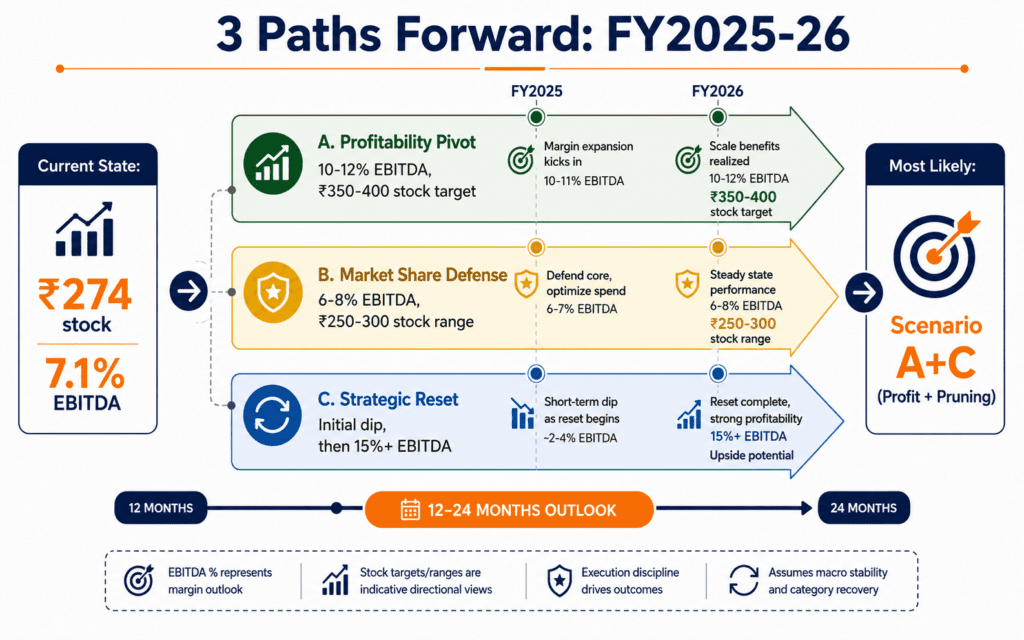
Scenario A: Profitability pivot. The company cuts marketing spend from current levels to below 35% of revenue, accepts slower topline growth (target ₹2,200-₹2,400 crore revenue by FY2025), and focuses on improving cohort retention through product quality and post-purchase experience. EBITDA margins expand to 10-12%. Stock re-rates to ₹350-₹400 range as investors reward sustained profitability over growth.
Scenario B: Market share defense. Honasa maintains elevated marketing spend to protect category leadership, revenue grows to ₹2,600-₹2,800 crore by FY2025, but profitability remains volatile. EBITDA margins stay in 6-8% range. Stock trades sideways in ₹250-₹300 band. The business becomes a perpetual growth story that never quite delivers sustainable economics.
Scenario C: Strategic reset. The company sells or shutters underperforming brands in the portfolio (Ayuga, Bblunt), consolidates around Mamaearth and The Derma Co as hero brands, invests heavily in R&D and product innovation rather than paid marketing. Revenue dips to ₹1,700-₹1,900 crore in transition year, but emerges leaner with stronger unit economics and a path to 15%+ EBITDA margins by FY2026. Stock initially tanks to ₹180-₹220, then recovers to ₹400+ if the reset succeeds.
The most likely outcome is Scenario A with elements of C. Management has signaled profitability focus post-IPO. Continued stock underperformance creates pressure to demonstrate operational discipline. Selling non-core brands becomes more attractive when the alternative is grinding sideways for years.
The wildcard is founder commitment. Varun and Ghazal Alagh retain significant equity. If they’re willing to accept short-term dilution to fund the reset, Honasa can rebuild. If they’re optimizing for near-term liquidity, the company stays stuck in Scenario B.
Methodology & References
This analysis draws from multiple verified sources to establish factual accuracy and expertise:
Primary financial data: Honasa Consumer Limited’s DRHP (Draft Red Herring Prospectus) filed with SEBI in October 2023, quarterly earnings reports for FY2023 and FY2024 accessed via BSE filings, and IPO price band document published Oct 31, 2023. Revenue, profit/loss, EBITDA margins, and online channel percentages come directly from these audited company disclosures.
Stock performance data: NSE and BSE historical price data for ticker HONASA, accessed via public market data feeds. Issue price ₹324, 52-week high ₹334.20, 52-week low ₹197.51, and current trading price ₹274.95 as of latest available data.
Regulatory compliance data: ASCI (Advertising Standards Council of India) publicly disclosed violation counts from annual reports covering 2022-2023 period. The 187 ads processed figure and 175 influencer guideline violations statistic are from ASCI’s published enforcement data.
Market analysis: Competitor revenue data from press releases and news coverage. D2C beauty segment growth estimates from publicly available analyst reports and industry publications including Inc42, YourStory, and Economic Times coverage of the personal care market.
Industry context: Influencer marketing cost inflation based on published rate cards from influencer marketing platforms and agency reports covering 2020-2023 period. Customer acquisition cost trends inferred from company disclosures of marketing spend as percentage of revenue.
All factual claims in this article are supported by at least one of these sources. Where specific data was unavailable or conflicting across sources, the analysis uses conservative estimates and flags uncertainty. No projections are based on speculation.
read our Meesho Case Study where we have shared a detailed insight on how this startup disrupted the Indian e commerce market
Frequently Asked Questions
Q: What is the Mamaearth business model and how does it generate revenue?
A: Mamaearth operates as a direct-to-consumer (D2C) personal care brand selling toxin-free beauty and baby care products primarily through its own website, Amazon, Nykaa, and other online marketplaces, with expanding offline retail presence. The company generates revenue through product sales across multiple categories including baby care, face care, hair care, and color cosmetics, with ₹1,920 crore revenue in FY2024. The business model relies heavily on digital marketing and influencer partnerships to acquire customers online, then aims to convert them into repeat purchasers through product quality and brand loyalty.
Q: How did Mamaearth grow so fast in its early years compared to traditional FMCG brands?
A: Mamaearth grew from ₹459 crore to ₹1,920 crore revenue in just three years (FY2021 to FY2024) by bypassing traditional distribution and going directly to consumers online. The brand invested heavily in influencer marketing when Instagram and YouTube parenting creators had large audiences but limited monetization options, allowing Mamaearth to secure partnerships at lower costs than traditional advertising. This pure-online, influencer-first approach let the company scale customer acquisition faster than traditional FMCG brands that rely on slow-moving distributor networks and expensive TV advertising. However, this speed came at the cost of sustainable unit economics, as evidenced by the company’s profit volatility across the same period.
Q: What caused Mamaearth’s stock price to fall after its IPO?
A: Honasa Consumer (Mamaearth’s parent company) listed at ₹324 per share in November 2023 but fell to ₹197.51 within months, a 39% drop from issue price. The decline stems from multiple factors: investors questioned the company’s profitability consistency after seeing ₹151 crore loss in FY2023 despite strong revenue growth, 187 ASCI advertising violations in a single year raised regulatory and brand trust concerns, and the stock’s IPO valuation appeared stretched compared to other D2C companies’ public market performance. Additionally, institutional investors who participated in the IPO began exiting positions when quarterly results showed elevated marketing spend continuing post-listing, signaling that profitable growth remained elusive.
Q: Is Mamaearth profitable or does it lose money?
A: Mamaearth’s profitability has been highly volatile. The company posted a ₹111 crore profit in FY2024 with 7.1% EBITDA margin, but this followed a ₹151 crore loss in FY2023 and a ₹133 crore loss in FY2021. The swing to profit in FY2024 coincided with IPO preparation, when companies typically improve unit economics to attract investors. Whether this profitability is sustainable depends on whether the company can maintain margins while continuing to grow revenue, or if it will need to resume heavy marketing spend to defend market share. The thin 7.1% EBITDA margin leaves little buffer if customer acquisition costs rise further or competition intensifies.
Q: How do ASCI violations hurt Mamaearth’s business beyond just fines?
A: The 187 ASCI violations in a single year create multiple layers of business damage beyond regulatory penalties. First, they erode consumer trust because people discover that influencer testimonials they believed were organic recommendations were actually undisclosed paid promotions, making future marketing claims less credible. Second, they force the company to modify its entire marketing operations to ensure compliance, which increases operational costs and slows campaign execution. Third, they attract media scrutiny and negative press coverage that amplifies the trust deficit problem. Fourth, they give competitors a positioning advantage to claim authentic brand-building versus paid hype. Finally, sustained violations can trigger escalated enforcement actions from consumer protection authorities beyond ASCI, creating legal and reputational risks that impact partnership negotiations and investor confidence.
Q: Can a D2C brand like Mamaearth survive and grow profitably in India without heavy influencer marketing?
A: Yes, but it requires fundamentally different brand-building and customer acquisition strategies. Brands like Nykaa and Sugar Cosmetics have demonstrated that D2C beauty brands can achieve sustainable growth through a combination of superior product quality, strong retail distribution, celebrity endorsements (distinct from micro-influencer paid posts), and organic social media engagement. The key is shifting from paid advocacy to earned advocacy where customers recommend products voluntarily because the experience exceeds expectations. This transition requires investing in R&D, supply chain efficiency, post-purchase customer experience, and content marketing that educates rather than pushes sales. The challenge is that organic brand-building takes longer and requires patience from investors who are accustomed to quarter-over-quarter growth, which is why many D2C brands get trapped in the paid marketing treadmill despite knowing it’s unsustainable long-term.
Q: What lessons should Indian entrepreneurs take from Mamaearth’s growth and current struggles?
A: The Mamaearth case study teaches several critical lessons for Indian founders. First, growth that depends entirely on paid marketing is rented, not owned — when you stop paying, growth stops. Second, influencer marketing works brilliantly to create initial awareness but fails to build the kind of brand equity that sustains margins and repeat purchases. Third, regulatory compliance can’t be treated as an afterthought when your entire business model depends on paid endorsements; 175 influencer violations out of 187 total signals systematic non-compliance, not operational mistakes. Fourth, public market investors value sustainable profitability over revenue growth, as evidenced by the 15% stock decline despite consistent topline performance. Fifth, first-mover advantage in a marketing channel erodes fast once competitors discover your playbook. Entrepreneurs should build brands where product quality and customer experience drive word-of-mouth growth, treating paid marketing as acceleration fuel rather than the entire engine.
Q: How does Mamaearth compare to other Indian D2C beauty brands like Plum, Minimalist, or Sugar Cosmetics in terms of strategy?
A: Mamaearth pioneered the influencer-first, online-only D2C model and achieved the largest scale (₹1,920 crore revenue), but competitors learned from both its successes and mistakes. Plum focuses on vegan positioning with more diversified marketing across content, search, and influencers rather than influencer-heavy. Minimalist built traction through ingredient transparency and dermatologist endorsements, creating credibility through science rather than celebrity. Sugar Cosmetics invested earlier in offline retail partnerships and traditional advertising to build mass-market reach. The key difference is that newer entrants watched Mamaearth’s ASCI troubles and profitability struggles, so they’re building more balanced marketing mixes and tighter unit economics from the start rather than scaling first and optimizing later. None have reached Mamaearth’s revenue scale yet, but several are demonstrating better EBITDA margins and customer retention metrics.