Building a startup is brutal. Most founders fail becuase they chase the wrong metrics and blindly copy the wrong leaders. They jump on whatever is trending without realizing that building a real business is never a short term game.
If you want real insights instead of generic advice, you need to look past the hype. You have to study the actual frameworks that work in the real world. This article shares 10 Kunal Shah insights and the exact sucess matrices he talks about.
Just so you know, he is not your average founder. He does not just launch apps to see what sticks. He has built massive ecosystems based entirely on raw human behavior.
Kunal Shah built massive companies by decoding psychology and consumer behavior. This guide covers his mental models, the 10 things to learn from Kunal Shah to build better products, and the specific founder mistakes to avoid. Real wealth creation comes from solving trust issues and creating status, not just handing out discounts.
Key Takeaways:
- Observe consumer behavior directly in the physical world.
- Focus on trust as your absolute core metric.
- Avoid common business mistakes entrepreneurs make by securing good unit economics early.
- Leverage high-trust networks to scale your startup.
My Story With Kunal Shah & Market Awareness
I was following Kunal Shah since the Freecharge era when freecharge was competing hard with paytm. FreeCharge is heavily studied in the startup ecosystem because of his unconventional appraoch to consumer behavior, marketing, and market metrics. Back then, people did not really trust online payments.
Shah spent over 500 cumulative hours standing in malls just watching people. He personally surveyed more than 2,000 people to understand if everyday consumers were actually ready to trust online transactions. That made me realies how important market research is.
Seeing that level of hustle changed my entire perspective. He did not rely on desk research or fancy consulting reports. He went directly to the people to gather the raw info. This hands-on experiance completely shaped my view on product building at One Vision Media.
You have to talk to your users to find the real friction in your bussiness. If you are sitting in a room guessing what your costumer wants, you are already losing to someone who is out there asking them.
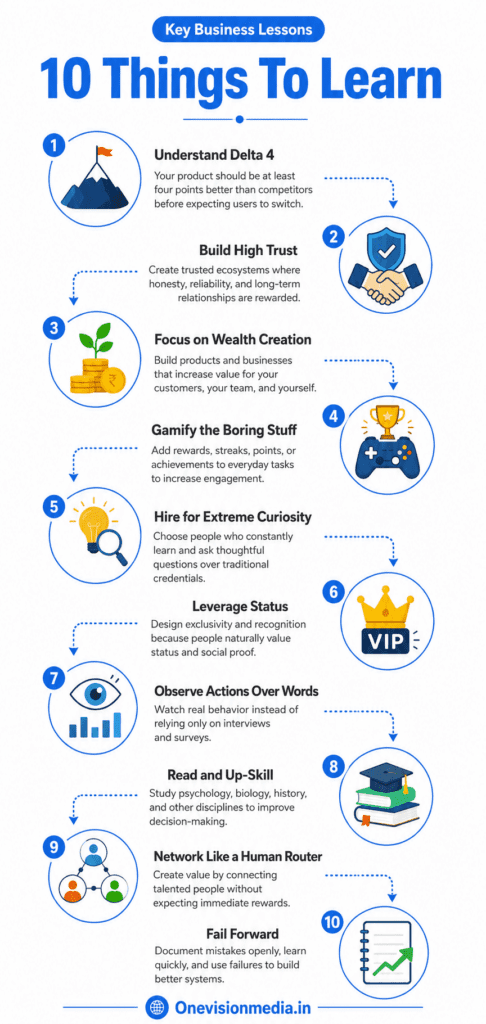
10 Things To Learn From Kunal Shah
Here are the top Kunal Shah success principles you can apply to your own comapny right now.
1. Understand The Delta 4 Framework
Kunal Shah startup advice always circles back to the Delta 4 theory. If your new product is not at least 4 points better than the old way on a 10-point scale, people will not switch. You cannot just be a little bit better or slightly faster. You have to be so good that going back to the old way feels painfully inefficient.
Make sure your product offers an undeniable upgrade to create massive lock-in.
2. Build High Trust Communities
One of the most valuble Kunal Shah business lessons is his intense focus on trust. In emerging markets, trust is notoriously low. If you can build a closed system where trust is financially rewarded, you win the game. CRED is built entirely on this single premise.
He realized that high-trust individuals are the most valuable costumers on the internet. Focus on building immense trust before you even think about aggressive monetization.
3. Focus On Wealth Creation
Many young founders obsess over valuation and fundraise announcements. True Kunal Shah entrepreneurship lessons teach us to focus on wealth creation instead. It is about expanding the finacial pie for everyone involved. Your team, your early investors, and your users should all get wealthier by associating with your brand.
This mindset shift fundamentally changes how you run your startup. You start playing long-term games instead of flipping features for quick cash.
4. Gamify The Boring Stuff
Paying credit card bills is incredibly boring and stressful. Kunal turned it into a game that people actually look forward to. He understands that adulting is hard and people desperately want small hits of dopamine. By gamifying a mundane financial task, he created incredibly sticky daily habits.
Look at your own product right now. Find clever ways to add small rewards for regular use to keep retention high.
5. Hire For Extreme Curiosity
When looking at Kunal Shah skills, his ability to curate untraditional talent is top tier. He actually prefers hiring curious people over those with standard corporate credentials. Curiosity drives innovation much better than a traditional degree does. Curious teams figure things out when the standard playbook completely fails.
Ask interveiw questions that test how a person thinks, not just what facts they memorized.
6. Leverage A Status Driven Society
People love status and want to show off. This is one of the most raw lessons from Kunal Shah that many founders ignore. CRED gives people a distinct sense of exclusivity becuase you need a high credit score just to get in. Creating a velvet rope makes people want to join your platform even more.
Think about how your product can elevate your user’s social standing among their peers.
7. Observe Actions Over Words
Remember my mall story earlier? Kunal observed actual physical behavior instead of just sending out generic email surveys. People often lie on surveys becuase they want to look smart or helpful. But their physical actions tell the real truth about their habits.
Watch how your users actually interact with your prototype in the real world. That is where the truely actionable data lives.
8. Constantly Read And Up-Skill
The man reads obsessively across multiple disciplines. His best insights come from studying biology, history, and philosophy. You cannot build massive companies just by reading tech blogs and Twitter threads. You need to understand human nature on a fundamental level.
Read outside your industry to find unique intersections.
9. Network Like A Human Router
He connects smart people constantly without asking for a cut. By being a central node in the network, he creates value for others without expecting an immediate return. This builds immense social capital over the years. When he needs to raise funds or hire a great manger, his network provides instantly.
Start connecting smart founders you know to each other today.
10. Fail Forward With Complete Transparency
FreeCharge had its struggles and he is very open about them publicly. Total transparancy builds massive credibility with investors and peers. Admitting what did not work shows maturity and self-awarness. Investors respect founders who know exactly why their last project failed.
Do not hide your missteps or try to spin them. Document your misteaks so your whole team learns from them.
The Evolution Of A Founder
To understand his growth, look at how his stratagy shifted between his two biggest ventures.
| Strategy Area | FreeCharge Era Approach | CRED Era Appraoch |
| Target Audience | Mass market internet users | Top 1% high credit score users |
| User Acquisition | Heavy discounts and cashbacks | Exclusivity and gated access |
| Core Metric | Gross transaction volume | High trust and daily engagement |
| Value Prop | Saving money on phone recharges | Elevating social status and rewards |
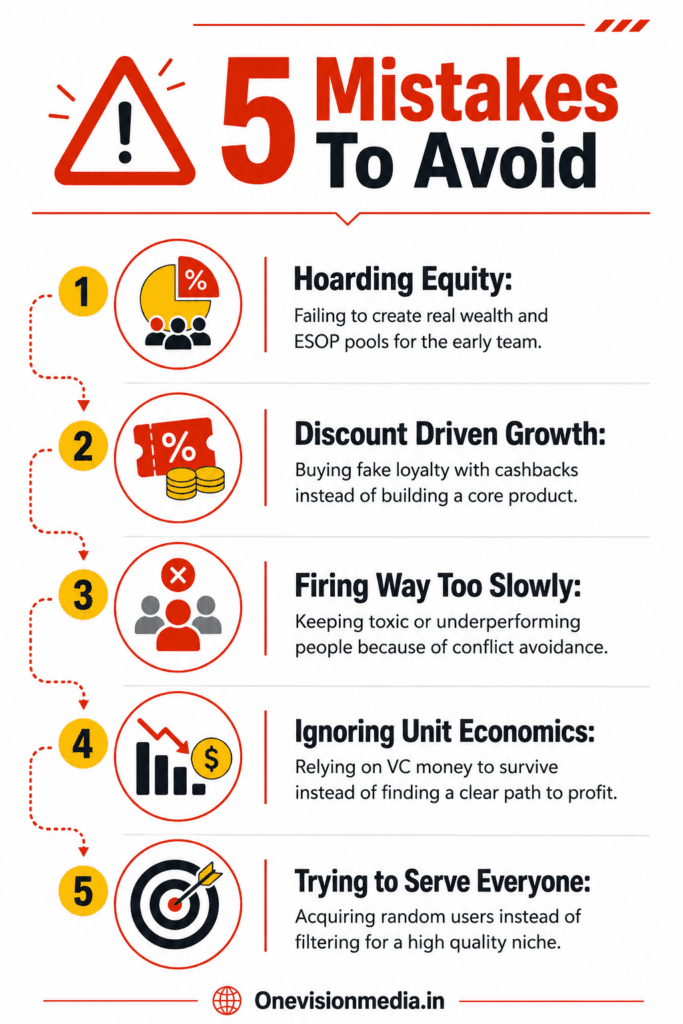
5 Kunal Shah Mistakes You Need To Avoid
Learning from sucess is fine, but as a founder, I believe analyzing real lessons from failure is mandatory. Kunal is smart, but he messed up on several fronts in his early days. These are the startup mistakes Kunal Shah talks about that cost his early ventures time and money. Here are the specific business mistakes entrepreneurs make that you need to sidestep completely.
1. Hoarding Equity From The Team
What he did wrong: In his early ventures, he held onto too much equity and failed to create real wealth for his initial team. He essentially got too tight with the cap table.
What you should do: Your early team takes a massive risk joining your bussiness on day one. One of the biggest founder mistakes to avoid is keeping the whole pie for yourself. Give your early employees solid ESOP pools so they win big when you win big.
2. Buying Users With Massive Discounts
What he did wrong: At FreeCharge, he burned through cash to acquire users via massive cashbacks and promo codes. He basically rented an audience of bargain hunters who had zero loyalty and left the second the discounts dried up.
What you should do: This is a crucial lesson from failure for anyone building consumer tech today. Stop bribing people to use your app just to show fake growth metrics to investors. You must build a core product that solves a real problem so people actually pay full price for it.
3. Firing Way Too Slowly
What he did wrong: He actively avoided uncomfortable conversations and kept the wrong people around for way too long. He let toxic or underperforming employees stay on the payroll simply becuase he hated the conflict of firing them.
What you should do: This is one of those mistakes every startup founder should avoid completely. If someone does not fit your culture, you are punishing your best employees by keeping the bad ones around. Have the tough talk and let them go respectfully but fast.
4. Running On VC Money Instead Of Unit Economics
What he did wrong: He and his team relied heavily on venture capital to survive instead of nailing down their actual profit margins. They scaled their losses rapidly hoping to figure out the real revenue model later.
What you should do: Do not use VC money to cover up a broken bussiness model. You need a very clear path to making actual money from day one. Secure your basic unit economics early so you never have to beg investors just to keep the lights on.
5. Building For The Entire Internet
What he did wrong: His early stratergy was to acquire every possible user he could find on the internet. That led to serving the masses without building a tight and highly engaged core comunity.
What you should do: Acquiring every random user just leads to a bloated product with zero direction. As a founder, you have to filter for high quality users who actually value your exact solution. Narrow your focus down and serve a very specific niche perfectly.
My Conclusion On Kunal Shah Framework
Building companies is exhausting work. My opinion is that learning from those who have done it twice at a massive scale is a total cheat code. Kunal Shah teaches us to look deeply at the psycholgy behind every single transaction. Apply these lessons to your own startup and you will definately see a massive shift in how you operate daily. Build for trust, optimize for status, and never stop observing your users.
Sources And References
- Early FreeCharge insights – Yourstory.com
- Kunal Shah Profile: Wikipedia
- Background on his philosophy degree: Linkedin Post
Frequently Asked Questions
Who is Kunal Shah?
He is a prominent Indian entrepreneur and angel investor. He is best known for founding two major fintech startups in India. He frequently shares startup advice and mental models with other founders.
What is Kunal Shah known for?
He is primarily known for founding FreeCharge and CRED. He is also famous in the startup ecosystem for his unique frameworks on consumer behavior. His Delta 4 theory is widely taught in product management circles.
Kunal Shah recommended books.
He recommends reading heavily outside of standard busines books. He frequently suggests books on evolutionary biology, psychology, and behavioral economics. He believes understanding human nature is more important than reading about management tactics.
Kunal Shah Knowledge Project.
He appeared on an incredibly popular podcast episode where he broke down his core mental models. This episode is considered mandatory listening for new startup founders. It covers how wealth is created and why trust is the ultimate currency.
Kunal Shah The Knowledge Project.
In this specific interview with Shane Parrish, he detailed the difference between India 1 and India 2 demographics. He explained why status drives almost all premium consumer behavior. If you want to understand his brain, start by listening to this exact episode.