Starting a business is exciting. Registering it is not.
I have seen lot of my founder friends spend months building an amazing product only to realise they picked the wrong business structure and now they are stuck. Then comes the painful part. Changing from current structure to other, that involves paying extra compliance costs, updating legal docs, and sometimes even losing investor interest.
But here’s the thing your business structure is not just a legal formality. It decides how much tax you may pay, whether your personal assets stay protected, how easily you can raise funds, and even how seriously banks and investors take you.
If you are stuck and wondering How To Choose Right Business Structure, this guide is written for you.
It is based on my personal knowledge and some of my founder friends practical experience, i made sure that the article is up to date with current Indian regulations, and the latest business registration framework available in 2026.
The Department for Promotion of Industry and Internal Trade (DPIIT) highlights five major startup structures including Sole Proprietorship, Partnership, One Person Company (OPC), LLP and Private Limited Company. Each comes with different rules around liability, compliance and fundraising.
Author
Hii Abhishek here the founder, author and proud Owner of the One Vision Media.
Over the last 10 years i have had the privilege of building and scalling multiple business some work some didn’t and it cost me lot of time and money and those lessons changed my thinking and decided to help new founders and that is the sole reason behind One Vision Media.
so without any more delay let’s dive into the article
What You Will Learn Today
- Why Business Structure Matters
- What Are The 4 Types Of Business Structures?
- Type Of Business List
- Business Structure Example
- How To Choose Right Business Structure In India
- 4 Common Mistakes First-Time Founders Make
- My Simple Founder Decision Framework
- Founder Tips I Wish Someone Told Me Earlier
- My Opinion
- FAQs
Why Your Business Structure Matters
So many new founders think that choosing a business structure is just about paperwork, but it isn’t. The structure you choose affects almost every part of your business. It determines lot of things.
- Legal liability
- Taxation
- Annual compliance costs
- Ability to raise investment
- Ownership flexibility
- Business credibility
- Long-term scalability
Think of it like you are building a house. If your foundation is weak, fixing the upper structure will not fix it and it will be expensive.
I feel a sharp pain in my chest when i see new founders register a Private Limited Company just because it “looked professional,” only to spend thousands every year on compliance despite earning low or very little. I have also seen businesses start as sole proprietorships and later struggle when investors asked them to convert into companies.
Choose the structure based on where your business is going, not where it is today think about future not present.
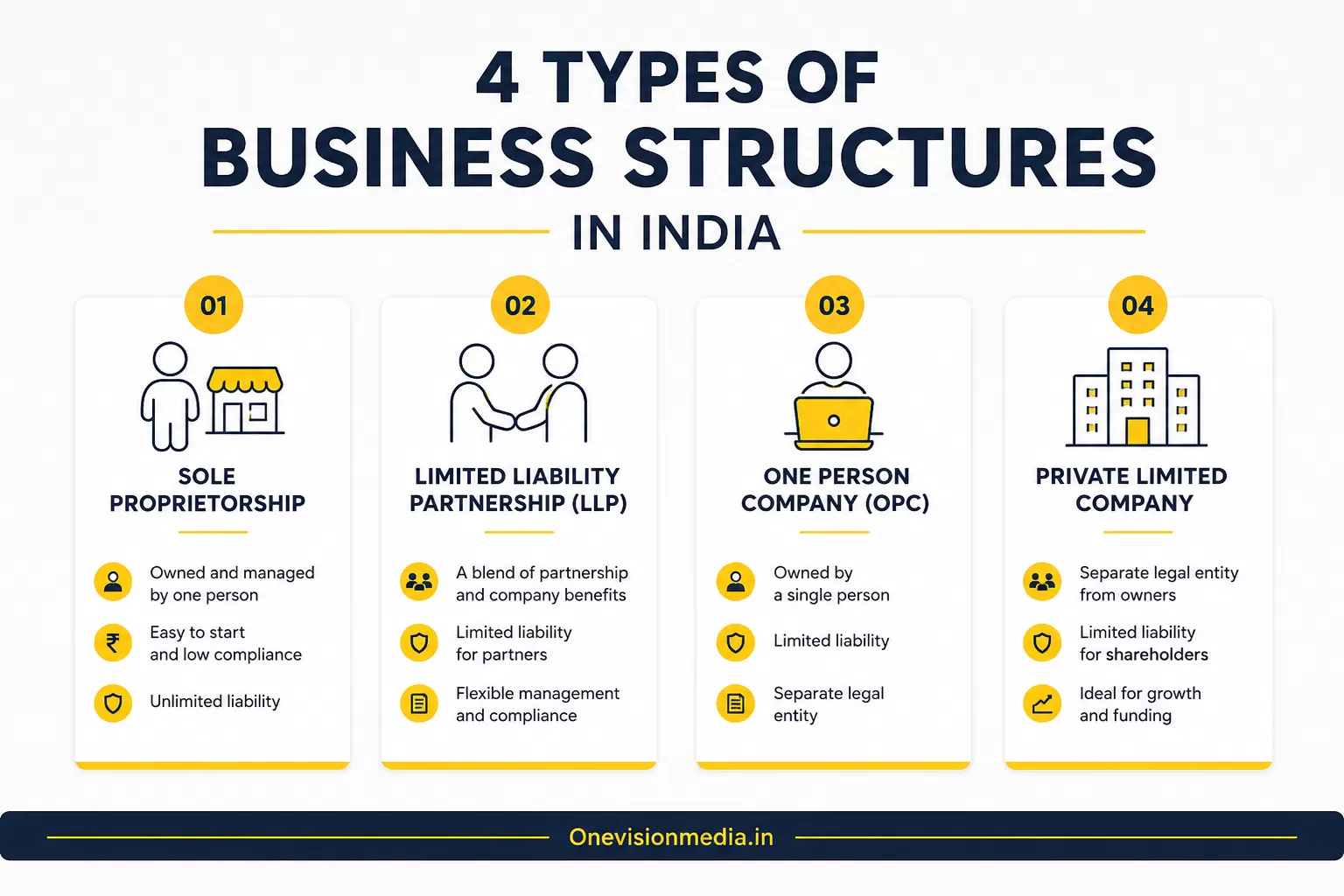
What Are The 4 Types Of Business Structures?
Although India has wide range of business and it is officially recognises, but these 4 types cover almost every startup and MSME.
1. Sole Proprietorship
This is the easiest business to start to in india, there is only one owner, minimal paperwork, and low setup cost.
It works well for:
- Freelancers
- Local shops
- Consultants
- Small online sellers
- Home businesses
The downside of this, there is no legal separation between you and your business. If your business incurs debt or faces legal action, your personal assets may also be at risk
2. Partnership Firm
Partnership option is suitable when two or more people are involved and want to run a business together as partner so partnership firm as it’s name suggest. Profits and responsibilities are shared according to the partnership agreement.
However this also have downside, partners usually carry unlimited liability, meaning one partner’s mistake can affect everyone, this structure still works for many family run businesses and traditional firms.
3. Limited Liability Partnership (LLP)
From my experience, I think LLP is one of the most balanced structures for many service businesses, Why? because it combines limited liability with relatively simpler compliance than a Private Limited Company.
LLPs are commonly chosen by:
- Marketing agencies
- CA firms
- Law firms
- IT companies
- Consulting businesses
If you don’t plan to raise venture capital soon, LLP can often be a smart choise.
4. Private Limited Company
If you’re building a startup with ambitious growth plans, this is usually the preferred option.
Private Limited Companies offer:
- Separate legal identity
- Limited liability
- Easier equity distribution
- Better investor confidence
- ESOP capability
- Stronger brand credibility
Most angel investors and venture capital firms prefer investing in Private Limited Companies because the ownership structure is clear and legally well defined.
We have created a step by step guide on How To Register Private Limited Company India MCA Guide 2026 you can check this out
Type Of Business List
| Business Structure | Best For |
|---|---|
| Sole Proprietorship | Freelancers, local stores, solo businesses |
| Partnership Firm | Family businesses, traditional partnerships |
| LLP | Agencies, consultants, professional firms |
| OPC | Single founder wanting limited liability |
| Private Limited Company | Startups planning to scale or raise funding |
| Section 8 Company | Non-profit organisations |
Business Structure Example
For those who is still confused let’s understand this with a practical example, imagine two friends start a digital marketing agency.
Scenario A
They register as a Partnership Firm business is doing great money is coming business is looking good graph is in upward trend and everything runs smoothly until one partner signs a bad contract, now both partners may become personally responsible for losses.
Scenario B
This time one of founder is a community member of Onevisionmedia and read our article and he knows risk and reward so instead of partnership, they register as an LLP.
Now the business becomes a separate legal entity, their personal liability is generally limited to their agreed contribution, making the overall risk much lower. That single decision could save lakhs of rupees later.
How To Choose Right Business Structure
If you are thinking i would chose the best one so let me correct you, there isn’t a “best” business structure, there is only the structure that best matches your goals. So whenever someone asks me which structure they should register, I give them these five questions checklist first.
1. Are You Starting Alone or With Partners?
If you’re the only founder, a Sole Proprietorship or OPC can be enough in the early stages.
If there are two or more founders, LLP or Private Limited Company usually makes more sense because ownership and responsibilities are clearly defined.
2. Do You Plan to Raise Investment?
This is probably the biggest deciding factor.
If you plan to approach angel investors or venture capital funds within the next few years, go with a Private Limited Company.
If you’re building a lifestyle business, agency, consultancy, or professional firm without external investors, LLP is often the simpler and more cost-effective option.
3. How Much Compliance Can You Handle?
Many first-time founders underestimate compliance, every business structure comes with different filing requirements, accounting responsibilities, and annual costs.
Ask yourself honestly, can you afford ongoing compliance, or would you rather keep things simple while validating your business?, sometimes spending less on compliance means you can spend more on customers.
4. What Is Your Risk Level?
If your business involves contracts, employees, manufacturing, imports, or financial risk, protecting your personal assets becomes important.
That’s where LLP, OPC, or Private Limited Company offer a major advantage because they provide limited liability under normal circumstances.
5. Where Do You Want Your Business To Be In Five Years?
This is the question most founders skip.
Don’t choose a structure only for today’s revenue, choose one that supports tomorrow’s vision if you’re planning to build a national brand, hire employees, issue ESOPs, or raise funding, starting with the right structure can save significant time and money later.
My Simple Founder Decision Framework
Here’s the framework I personally use when helping and mentoring new founders. It’s not a legal rule, it’s simply a practical framework that works for most businesses and have worked for me.
| If You Are… | I Would Recommend |
|---|---|
| Freelancer or side hustler | Sole Proprietorship |
| Solo founder wanting legal protection | OPC |
| Agency, consultant or service business | LLP |
| Startup planning funding | Private Limited Company |
| NGO or charitable organisation | Section 8 Company |
4 Common Mistakes First-Time Founders Make
I have seen new founders doing these mistakes again and again and it pains me everytime.
1. Registering a Private Limited Company Too Early
Many founders believe it makes them look more professional professionalism comes from customers, revenue, and execution not from the words “Private Limited.” A company with zero customers but heavy compliance isn’t a win.
2. Ignoring Future Funding Plans
Some founders register as Sole Proprietors because it’s quick six months later they receive investor interest now they have to restructure the business before closing the investment. That process takes time, costs money, and creates unnecessary paperwork.
3. Choosing Based Only on Registration Cost
Registration is a one-time expense compliance continues every year always calculate the total cost over the next three to five years instead of looking only at incorporation fees.
4. Not Consulting a Professional
Google is useful, AI tools are useful articles like this are useful.
But before filing incorporation documents, spend one hour with a qualified Chartered Accountant or Company Secretary, that small investment can save you from expensive mistakes later.
Check out Complete guide to registering a Private Limited Company in India
Founder Tips I Wish Someone Told Me Earlier
If I could sit with every first-time entrepreneur, these are the points I’d share.
- Don’t copy your friend’s business structure.
- Don’t register before validating your idea.
- Keep future funding plans in mind.
- Separate personal and business finances from Day 1.
- Maintain proper accounting records from the beginning.
- Review your structure every few years as your business grows.
Most businesses evolve, your legal structure can evolve too, but changing it later usually costs more than choosing wisely at the beginning.
My Opinion And Recommendation
If you’re still confused, here’s my practical advice Choose Sole Proprietorship if you’re testing an idea with minimal risk Choose OPC if you’re building alone and want limited liability Choose LLP if you’re running an agency, consultancy, or professional service business without plans for VC funding Choose Private Limited Company if you’re serious about scaling, hiring aggressively, issuing equity, or raising external capital.
Don’t choose based on trends choose based on where you want your business to be three years from now.
Ministry of Corporate Affairs guide on company incorporation and compliance
After helping founders over the years, I’ve noticed something interesting most businesses don’t fail because they picked the wrong legal structure they fail because they spend weeks worrying about registration instead of getting customers yes, choosing the right business structure matters but don’t let it become an excuse to delay launching your business.
- Validate your idea.
- Talk to customers.
- Generate revenue.
Then build the strongest legal foundation possible that’s the order I’d follow if I were starting from scratch today.
Frequently Asked Questions
What is better for a small business LLC or corporation?
For small businesses in India, an LLP is the closest alternative to an LLC and works well for agencies, consultants, and service-based businesses. If you plan to raise investment, issue shares, or scale rapidly, a Private Limited Company is generally the better option.
What are the business structure types in India?
The main business structure types in India are Sole Proprietorship, Partnership Firm, One Person Company (OPC), Limited Liability Partnership (LLP), Private Limited Company, and Section 8 Company. Each structure differs in ownership, liability, taxation, compliance, and fundraising capability.
What is the best business structure for startups in India?
For startups planning to raise funding and grow quickly, a Private Limited Company is usually the preferred choice. If you’re building a small service business without external investors, an LLP often provides a better balance between legal protection and compliance.
Which business structure has the lowest compliance in India?
A Sole Proprietorship generally has the lowest compliance requirements and is the easiest business structure to start in India. However, it does not provide limited liability, meaning your personal assets may be exposed to business risks.
Can I change my business structure later?
Yes, you can change your business structure as your business grows. For example, many entrepreneurs start as a Sole Proprietorship or LLP and later convert to a Private Limited Company when they need investment, better credibility, or expansion opportunities.