What is LTV in business? in business terms LTV stands for Lifetime Value. It is the total amount of pure money a single customer will spend with your brand during thier entire relationship with you.
If a user pays ₹1000/- a month for your SAAS Product and stays for 12 months, thier Lifetime Value is ₹12000/- . It is the ultimate metric for measuring customer loyalty and long term buisness health. It proves that you are actually keeping the users you worked so hard to get.
Decoding Business Jargons
Hey, Abhishek here. Welcome back to our Decoding Buisness Jargons series for One Vision Media. We are taking those scary corporate and VC terms and breaking them down into simple English.
Last time we talked about the cost of getting a customer (CAC). Today we tackle the other half of the puzzle which is how much that customer is actually worth. You do not need an MBA to get this right. We are going to look at exactly how to track this so you can build a highly profitable company.
What You Will Learn Today
Here is a quick look at exactly what we are going to cover in this artical so you can skip around if you need to:
- The Leaky Bucket Problem
- What Is LTV In Business?
- How To Calculate LTV
- LTV Example
- Why LTV Matters
- Key Factors of Ltv
- LTV, CAC & Churn Rate
- Common Mistakes Founders Make
- How To Fix And Optimize Ltv
- Best Software Tools For LTV Prediction
- My Final Take
- Frequently Asked Questions
The Leaky Bucket Problem
You just launched your new SaaS product. People are signing up and the Stripe payment notifications are pinging on your phone. It feels absolutely amazing.
But three months later, you notice a massive problem. Half of those new users are canceling thier subscriptions. You are spending thousands of rupees on Facebook ads but your monthly revenue is completly stuck. Your bank account is flatlining.
This is the exact moment founders panic. and start finding solution for this mess so don’t wait for that time, If you are losing customers just as fast as you aquire them, you have a leaky bucket it is as simple as that.
Understanding and extending this single metric is the only way to escape the constant, tiring hustle of finding brand new buyers every single day.
What Is LTV In Business?
Let me define what is ltv. It is a highly educated prediction of the net profit attributed to the entire future relationship with a single customer.
Instead of looking at a single checkout cart transaction, you zoom out. You look at the whole picture from the first swipe of thier credit card until the day they finaly delete thier account.
For recurring revenue models this is the holy grail. You put in the hard work and marketng expences to aquire a user once. Then you harvest that recurring profit month after month after month.
If your users stick around for years, you can afford to hire better developers and build better features. If they leave after two weeks, you will go bankrupt. It is realy that simple.
How To Calculate LTV
The ltv formula is actually pretty straightforward once you break it down into pieces. You do not need a degree to figure this out.
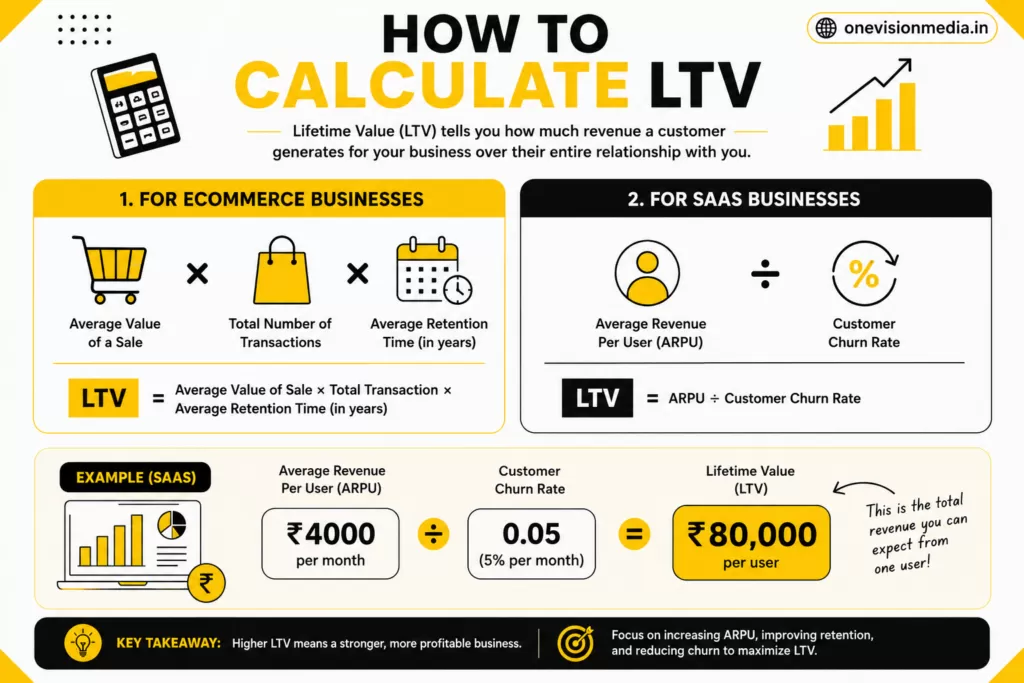
For a traditional ecommerce store, you multiply the average value of a sale by the total number of transactions. Then you multiply that number by the average retention time period in years.
But for a monthly SaaS product it is much simpler. You just take your Average Revenue Per User (ARPU) and divide it by your Customer Churn Rate.
Formula: ARPU / Customer Churn Rate = Lifetime Value.
Let us say you make ₹4000/- per user every single month. Your monthly churn rate is 5 percent (which you write as 0.05). You divide ₹4000/- by 0.05. Your final answer is ₹80,000/-.
LTV Example
Let us look at a detailed example of what is LTV. We will use a B2B SaaS tool since those are booming in India right now.
Imagine you built a custom software platform for automated lead generation. Your system scrapes the web and hands warm leads to digital marketng agencies.
You charge these agencies a flat fee of ₹5000/- every single month. Your product is solid. Because it makes them money, most agencies stick around for about 24 months before they close thier buisness or move to a competitor.
To find your metric, you simply multiply 5000 INR by 24 months. Your average customer lifetime value is ₹1,20,000/-.
Before you start celebrating that massive number, make sure your actual company is legally registered to handle that level of cash flow. If you have not done your paperwork yet, check out our Udyam Registration Complete Step-by-Step Guide to get your buisness entity sorted fast.
Why LTV Matters
Why is this single number so importent for your survival? Becuase it dictates exactly how much cash you can safely afford to spend on your marketng campaigns.
If you know a user will eventually pay you 1 Lakh over two years, you can confidently spend ₹10,000/- today to aquire them. You know the math works out in your favor in the long run.
It also tells you if your product is actually solving a real problem. High retention means you built something people desperately need. If your users cancel after one month, your software is probably buggy or confusing.
Investors also obsess over this number. If you want to raise a seed round from venture capitalists, they will demand to see your retention data. A high value proves you have a sticky product.
Key Factors of Lifetime Value
Several different elements inside your company affect this metric on a daily basis. You need to monitor all of them closely.
Your user onboarding process is the biggest factor. The first 48 hours dictate if a user stays for years or leaves tomorrow. If they get confused during setup, thier lifetime value drops to zero.
Customer support quality is another massive factor. When a user runs into a bug, a fast and helpful reply from your team builds insane loyalty. A slow reply makes them cancel instantly.
Product update frequency also matters deeply. Every time you release a new feature that saves your user time or makes them money, thier overall value goes up. They have no reason to look at your competitors.
LTV, CAC and Churn Rate
You cannot talk about this topic without looking at its two best friends. They are all deeply connected inside your buisness engine.
If you read my last guide, you already know about aquisition costs. If you missed it, you absolutely need to read our What is CAC in Business Guide to understand this delicate balance.
Your LTV to CAC ratio is the ultimate health check for a startup. A healthy SaaS buisness needs a ratio of at least 3:1. This means you make three times more money from a user than it cost you to get them.
Churn rate is the ultimate enemy. Churn is the percentage of people who cancel thier service every month. If your churn rate goes up even slightly, your lifetime value instantly drops like a rock.
| Startup Health Ratio (LTV to CAC) | What It Means For Your Buisness | Action Required |
|---|---|---|
| 1:1 Ratio | You are losing money on every sale after operational costs. | Stop all paid ads immediately and fix the product. |
| 2:1 Ratio | You are barely breaking even. Growth will be very slow. | Work heavily on upselling existing users. |
| 3:1 Ratio | The sweet spot. You have a solid, sustainable buisness model. | Keep scaling your current marketng channels. |
| 5:1 Ratio | You are highly profitable but growing too slowly. | Spend much more on ads to capture more market share. |
Common Mistakes Founders Make
Founders make a lot of errors when tracking this data. These mistakes will give you a completely false sense of security.
- 1st. Is ignoring your gross margin. If a customer brings in 1 Lakh over two years, but your AWS server costs and API fees eat up 80 percent of that revenue, your true value is way lower. Always calculate based on profit, not just top line revenue.
- 2nd. Is blending all your customers together into one giant average. Your enterprise clients on yearly contracts have a massive value. Your free trial users who converted on a massive discount do not. You must seperate your data into different cohorts.
- 3rd. Is trying to fix this metric by blindly raising prices. If you double your monthly price but you do not improve the actual software, everyone will leave. Your churn will spike and your overall value will crash completely.
How To Fix And Optimize Ltv
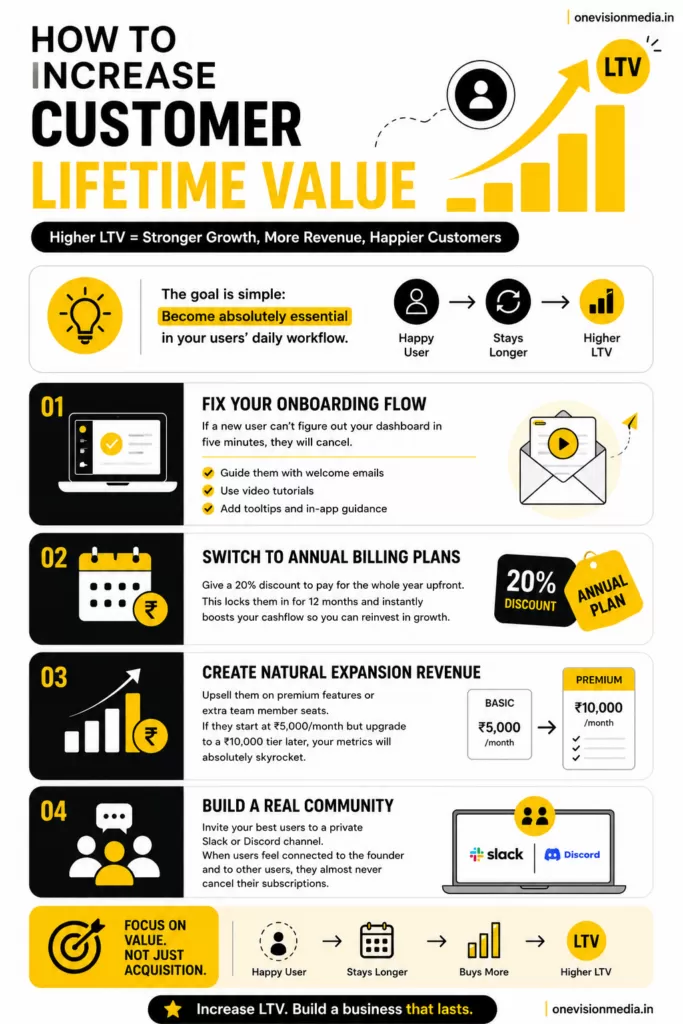
Lot ot my Founders friends always ask me what we can do to improve our ltv customer lifetime value, one of them is a saas company founder so let’s take example of that so how can a SaaS company can use LTV to improve customer retention? and the answer is by becoming absolutely essential to thier users daily workflow.
How to Increase Customer Lifetime Value
- You must fix your onboarding flow. If a new user cannot figure out your dashboard in five minutes, they will cancel. Hold thier hand with welcome emails, video tutorials, and tooltips.
- Switch people to annual billing plans. Give them a 20 percent discount to pay for the whole year upfront. This locks them in for 12 months and instantly boosts your cashflow so you can reinvest in growth.
- Create natural expansion revenue. Upsell them on premium features or extra team member seats. If they start at 5000 INR a month but upgrade to a 10000 INR tier later, your metrics will absolutely skyrocket.
- Build a real community. Invite your best users to a private Slack or Discord channel. When users feel connected to the founder and to other users, they almost never cancel thier subscriptions.
Read this Harvard Business Review study on the economics of customer loyalty to see how tiny retention improvements create massive profit gains.
Best Software Tools For LTV Prediction & Analysis
You do not need to do this complex math in your head or in a messy spreadsheet. There are amazing tools out there to help you track everything automatically.
For SaaS products, ProfitWell is incredible and completly free to use. It plugs right into your Stripe account and shows your exact retention metrics and churn rates on a beautiful dashboard.
Baremetrics is another very popular paid option. It gives you deep insights into exactly why people are canceling so you can fix the root cause of the problem.
If you realy want to dive deeper into the advanced math behind this, you might want to find online courses on LTV modeling and optimization. Platforms like Reforge or Udemy offer great masterclasses on this specific topic taught by industry veterans.
My Final Take
At the end of the day, startup growth is not just about getting more traffic to your website. Real sustainable growth is keeping the people you already have.
If you focus all your energy on fixing your product so people never want to leave, the marketng becomes incredibly easy. You stop worrying about every single ad campaign becuase your user base is compounding naturally.
Calculate your baseline number today. Then spend the next month talking directly to your best users to figure out exactly how to make them stay forever.
Frequently Asked Questions
What is the full form of ltv in business?
The full form is Lifetime Value. Sometimes it is also written as CLV which stands for Customer Lifetime Value. Both terms mean the exact same thing.
What is ltv in business terms?
In buisness terms, it is the total net profit a company expects to earn from a single customer over the entire duration of thier relationship. It measures long term financial value rather than just a single purchase.
What is LTV in business and how is it calculated?
It is a metric of customer loyalty. It is calculated by multiplying your average order value by your purchase frequency, and then multiplying that result by the average customer lifespan in years or months.
What is ltv in business loan?
This is a very common point of confusion. In the banking and real estate world, it stands for Loan-to-Value ratio. It compares the amount of a loan to the actual market value of the property being purchased. It has nothing to do with marketng or SaaS metrics.