Meesho is India’s largest e-commerce platform by order volume—1.3 billion orders in nine months—yet it ranks third in GMV behind Amazon and Flipkart. The reason: an average order value of just ₹315-₹350 compared to competitors’ ₹800-₹1,200. Founded in 2015 as a hyperlocal fashion app, Meesho pivoted four times before finding its model: a zero-commission marketplace targeting tier 2, 3, and 4 cities where 45% of festive-sale buyers come from tier 4 and beyond. With $1.68 billion raised and a $3.9-4 billion valuation, Meesho is preparing for an IPO while operating near break-even—losing just ₹108 crore on core operations in FY25 despite ₹9,390 crore revenue. This Meesho case study dissects how survival through iteration and ignoring the metro playbook created India’s highest-volume e-commerce business.
“We were two engineers from IIT Delhi trying to understand how to build a startup. We had no background in commerce, no family business, no experience in retail, just curiosity and willingness to figure it out”
— Sanjeev Barnwal | Co-Founder of Meesho
Who Founded Meesho? The IIT-Delhi Duo Behind India’s Largest E-commerce Platform by Orders
Meesho was founded in December 2015 by Vidit Aatrey and Sanjeev Barnwal, both IIT-Delhi graduates who met during their undergraduate engineering program. Aatrey, who studied Mechanical Engineering, and Barnwal, a Computer Science graduate, left corporate jobs at ITC and Sony India respectively to launch what would become India’s highest-volume e-commerce business.
The Meesho founder story begins not with e-commerce but with a failed hyperlocal fashion experiment called Fashnear Technologies. Aatrey and Barnwal initially built a Swiggy-for-fashion app connecting users to nearby boutiques for same-day delivery. When that model collapsed within months due to inconsistent inventory and low merchant adoption, the duo didn’t quit. They noticed homemakers and small sellers using WhatsApp groups to sell products and pivoted to build tools for social reselling.
What sets the Meesho founders apart from typical Silicon Valley-trained entrepreneurs is their willingness to pivot toward structural advantages rather than compete head-on with Amazon and Flipkart. By 2019, Meta invested $125 million in Meesho, marking Facebook’s first-ever Indian startup investment and validating Aatrey and Barnwal’s thesis that tier 2-3 India needed a different e-commerce model. The zero-commission decision in July 2021 exemplifies their contrarian thinking: instead of copying incumbents’ revenue models, they built one Amazon and Flipkart couldn’t replicate without destroying their own margins.
As of April 2026, under Aatrey’s leadership as CEO and Barnwal’s technical direction, Meesho has raised $1.68-1.7 billion and is preparing for an IPO at a $3.9-4 billion valuation. The company serves 187 million transacting users and processes 4.9 million orders daily, making it the largest Indian e-commerce platform by order volume despite an average order value of just ₹315-₹350. Both founders remain actively involved in product and strategy decisions as Meesho approaches profitability, losing only ₹108 crore on core operations in FY25 despite ₹9,390 crore revenue.
Proprietary Data Breakdown: Meesho vs Amazon vs Flipkart—The Tier 2-3 Battle
The Meesho business model tells a counterintuitive story: you can win on volume while losing on value. Here’s the competitive landscape as of FY25:
| Metric | Meesho | Amazon India | Flipkart |
| Annual GMV | ~$6.2 billion (₹51,000 crore) | ~$38-40 billion | ~$23-30 billion |
| Order Volume (Apr-Dec 2024) | 1.3 billion orders (~4.9M/day) | Not disclosed; implied by GMV/user base | Not disclosed; implied by ₹1.76L crore GMV |
| Active Users | 187 million transacting users (ATU) | 150M+ estimated users | Significant tier 2-3 penetration, no single % |
| Tier 2-3-4 Penetration | “Overwhelming majority” from tier 2-3-4; 45% festive buyers from tier 4+ | ~60% of new sale users from tier 2-3 (2026) | Strong tier 2-3 but no published % |
| Average Order Value (AOV) | ₹315-₹350 | ₹800-₹1,200+ (electronics/premium skew) | ₹800-₹1,200+ (branded categories) |
| Commission Structure | 0% seller commission since July 2021 | 2-15%+ by category + logistics fees | ~₹100-₹120 per order + advertising fees |
| Revenue Model | Logistics fees, advertising, value-added services | Commission + advertising + logistics | Marketplace fees + ads + logistics |
| Profitability Status | Near break-even on core operations (₹108 crore loss FY25) | Not publicly disclosed for India operations | Not publicly disclosed |
What the data reveals:
Meesho’s 37% share of India’s e-commerce order volume represents only 8.5-10% of GMV. This isn’t a bug; it’s the strategy. While Amazon and Flipkart chase high-ticket electronics and branded fashion in metros, Meesho dominates unbranded apparel, home goods, and beauty products in Chhattisgarh, Jharkhand, and Bihar. The ₹315 AOV reflects real purchasing power in tier 3-4 cities, not a race to the bottom.
The Meesho marketing strategy doesn’t compete on Prime-style delivery speed or brand partnerships. It competes on product selection (140M+ listings vs Amazon’s curated catalog), language accessibility (vernacular interface), and zero-commission pricing passed through to consumers. When your competitor charges sellers 10-15%, you can undercut on price without a margin disadvantage.
The risk: profitability at scale. Meesho’s ₹9,390 crore revenue against ₹3,941 crore net loss (though only ₹108 crore core loss) shows the path is narrow. Unit economics work when logistics fees, advertising, and value-added services cover platform costs, but only if order volume keeps growing faster than customer acquisition costs.
How Meesho Won After Losing 3 Times: Technical Deconstruction
The 4 Pivots—From Fashion Discovery to E-commerce Dominance
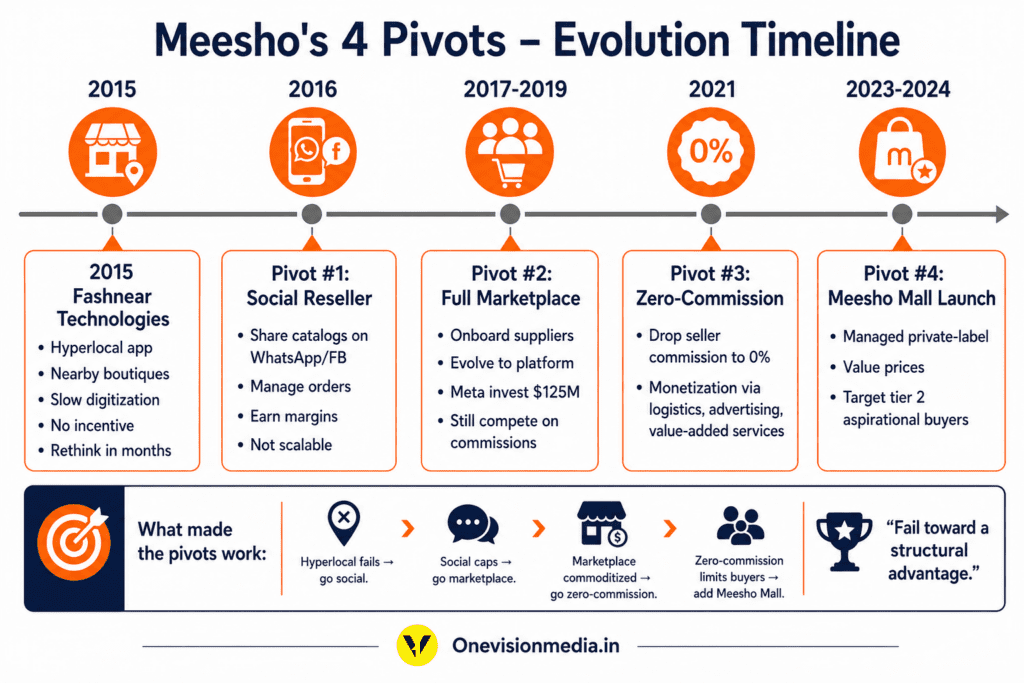
Understanding why Meesho succeeded after pivots requires understanding what failed first. Here’s the timeline:
2015 – Fashnear Technologies: The Swiggy-for-Fashion Mistake
IIT-Delhi graduates Vidit Aatrey and Sanjeev Barnwal launched a hyperlocal app connecting users to nearby boutiques for same-day fashion delivery. The problem: offline boutiques had inconsistent inventory, slow digitization, and no incentive to pay platform fees. Limited traction forced a rethink within months.
2016 – Pivot #1: Social Reseller Platform
The Meesho founders noticed homemakers and small sellers using WhatsApp and Facebook groups to sell products. They built a “social commerce” app that let anyone share product catalogs, manage orders, and earn margins without holding inventory. This worked—but it wasn’t scalable beyond social networks.
2017-2019 – Pivot #2: Full Marketplace Transition
Meesho onboarded thousands of suppliers and evolved from social-first to a full marketplace. By 2019, Meta invested $125 million—Facebook’s first Indian startup bet—validating the model. But Meesho still competed on commission rates (5-10%) like everyone else.
2021 – Pivot #3: Zero-Commission Model
In July 2021, Meesho dropped seller commissions to 0%. This wasn’t altruism; it was survival math. Amazon and Flipkart could outspend Meesho on logistics and customer acquisition. But they couldn’t drop commissions without destroying their revenue model. Meesho could, because it would monetize differently: logistics fees (charged per delivery), advertising (promoted listings), and value-added services (working capital tools for sellers).
2023-2024 – Pivot #4: Meesho Mall Launch
To move upmarket without abandoning tier 2-3, Meesho launched Meesho Mall—a managed private-label section offering “branded-style” products at value prices. This targets aspirational buyers in tier 2 cities who want quality signals but can’t afford Amazon’s premium catalog.
What made the pivots work:
Meesho didn’t pivot randomly. Each shift responded to a structural constraint: hyperlocal logistics don’t scale → go social. Social distribution caps at network effects → go marketplace. Marketplace competition is commoditized → go zero-commission. Zero-commission limits premium buyers → add Meesho Mall. The lesson from Meesho pivots isn’t “fail fast”—it’s “fail toward a structural advantage your competitors can’t copy.”
The Zero Commission Model — Unit Economics That Shouldn’t Work But Do
Here’s the Meesho unit economics puzzle: if you don’t charge sellers, where does the money come from?
Revenue Stream #1: Logistics Fees
Meesho charges buyers or sellers (depending on category) for delivery. Since Meesho uses third-party couriers, not a proprietary fleet, variable costs stay low. On 4.9 million daily orders, even a ₹20-30 logistics margin per order generates ₹3,000-4,500 crore annually—roughly a third of Meesho’s ₹9,390 crore FY25 revenue.
Revenue Stream #2: Advertising
Sellers pay for visibility. Promoted listings, category placements, and Meesho Mall featured spots drive advertising revenue. As 513,757 sellers compete for attention, advertising scales without increasing logistics costs. Industry estimates suggest ads contribute 20-25% of Meesho’s revenue.
Revenue Stream #3: Value-Added Services
Working capital products (short-term loans to sellers), premium analytics tools, and reverse-logistics support add margin on top of core transactions. This is growing but still a smaller slice.
Why the math works:
Meesho’s ₹315 AOV means each order generates less gross merchandise value (GMV) than Amazon’s ₹1,200 orders. But 1.3 billion orders at ₹30 margin beats 300 million orders at ₹100 margin if your cost structure is lighter. Meesho doesn’t warehouse inventory, doesn’t run a delivery fleet, and doesn’t subsidize discounts. It’s a pure platform play where volume compensates for thin margins.
The risk: if returns spike (common in unbranded fashion), reverse logistics eats margin. If tier 2-3 buyers shift to quick commerce or social shopping outside Meesho’s platform, order volume stalls. And if Amazon or Flipkart launch zero-commission verticals, Meesho’s structural edge disappears.
The Invisible Variable—Why Tier 2-3 Shoppers Trust Meesho Over Amazon
This is the hardest part of the Meesho vs Amazon comparison to quantify: psychological fit.
Language and Interface
Meesho’s vernacular UI (Hindi, Tamil, Telugu, Bengali) isn’t a feature—it’s the product. In tier 3-4 cities, English literacy correlates with income, and income correlates with Amazon adoption. Meesho targets the next 500 million internet users, not the first 150 million.
Product Selection Matches Local Demand
Amazon optimizes for gross margin, so its catalog skews toward branded electronics, premium fashion, and high-AOV categories. Meesho optimizes for order volume, so its 140M+ listings include ₹99 kurtis, ₹50 kitchen tools, and unbranded home decor. A Patna homemaker doesn’t need Nike; she needs affordable sarees for Diwali. Meesho’s catalog reflects that.
Delivery Expectations vs Reality
Amazon’s “next-day delivery” promise breaks down in tier 3-4, where last-mile infrastructure is inconsistent. Meesho commits to 1-3 days and hits it more reliably because expectations are calibrated to ground truth. Underpromise and overdeliver beats overpromise and underdeliver.
Social Commerce Legacy
Meesho’s roots as a social reseller platform mean many tier 2-3 users discovered it through WhatsApp groups or local influencers, not performance marketing. Trust transferred socially is stickier than trust built on brand advertising.
The SWOT analysis of Meesho reveals this as both a strength and a vulnerability: if Amazon figures out tier 3-4 psychology and invests in vernacular localization, Meesho’s moat shrinks. But as of 2026, Amazon still treats tier 2-3 as “metro-lite,” not a distinct market.
Implementation Framework: The Meesho Playbook for Tier 2-3 Penetration
If you’re building for Bharat, here’s what Meesho got right that you can replicate:
Step 1: Identify a structural disadvantage your competitors accept as immovable
Amazon accepts that commission-based marketplaces are the only model. Meesho rejected that and built around zero-commission. Your version: what does your industry assume is “just how it works” that you can bypass?
Step 2: Build for AOV reality, not aspiration
Don’t try to “elevate” tier 3 users to metro spending habits. A ₹315 AOV business at scale beats a ₹1,200 AOV business that never reaches scale in those geographies. Match product catalog and pricing to what people actually buy, not what you wish they’d buy.
Step 3: Optimize for trust transfer, not brand recognition
Meesho grew through WhatsApp groups and local resellers before scaling paid marketing. In tier 2-3, word-of-mouth compounds faster than Instagram ads. Find teh distribution channel where trust already exists and plug into it.
Step 4: Calibrate promises to infrastructure reality
Don’t promise 2-hour delivery in tier 4 cities where courier partners take 2 days. Set expectations you can beat, not aspirations you’ll miss. Reliability > speed in markets where speed isn’t physically possible yet.
Step 5: Monetize differently than the incumbents
If your competitors make money one way (commission), build a model where you make money differently (logistics + ads + services). This lets you compete on price without bleeding cash indefinitely.
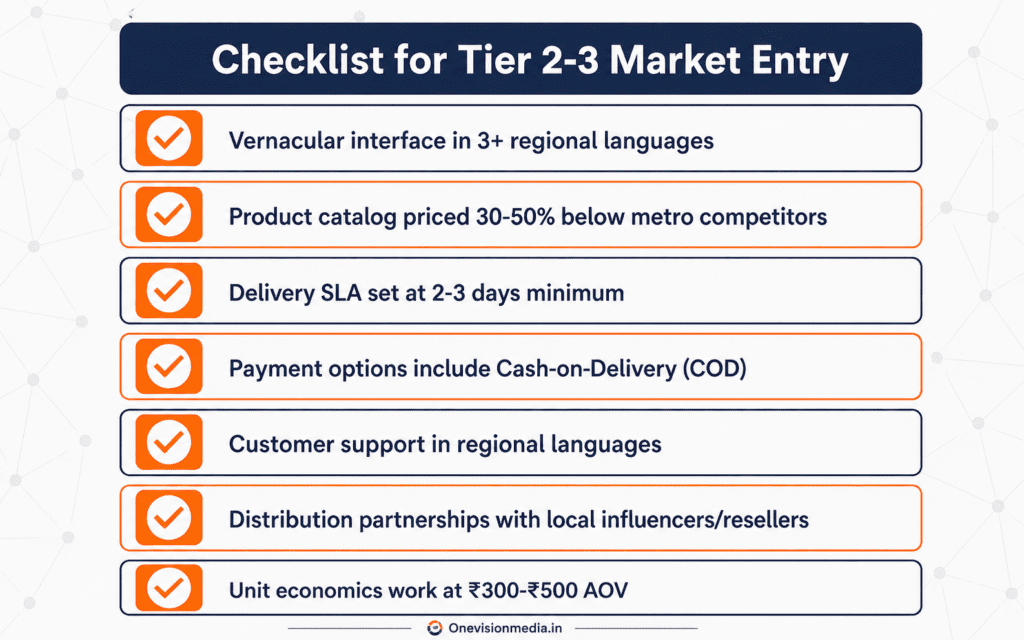
Checklist for Tier 2-3 Market Entry:
☐ Vernacular interface in 3+ regional languages
☐ Product catalog priced 30-50% below metro competitors
☐ Delivery SLA set at 2-3 days minimum (don’t overpromise)
☐ Payment options include COD (cash-on-delivery still dominates tier 3-4)
☐ Customer support in regional languages, not just English
☐ Distribution partnerships with local influencers/resellers
☐ Unit economics that work at ₹300-₹500 AOV, not ₹1,000+
Forecast & Strategic Outlook: Can Meesho Survive the Next 24 Months?
Meesho’s $3.9-4 billion IPO valuation target and 2026 expected listing set up three scenarios for the next 12-24 months:
Scenario 1: The Profitability Path (40% probability)
If Meesho hits ₹12,000-15,000 crore revenue in FY26 while keeping core losses under ₹200 crore, it proves the zero-commission model scales profitably. Advertising revenue grows as seller competition intensifies. Logistics margins improve through AI-driven route optimization and volume discounts with courier partners. The IPO values growth + near-profitability at $5-6 billion post-listing. Meesho future strategy 2026 focuses on Meesho Mall expansion and premium-tier monetization without abandoning tier 2-3.
Scenario 2: The Stagnation Squeeze (35% probability)
Quick commerce (Zepto, Blinkit) and social commerce (Instagram Shops, WhatsApp Business) fragment tier 2-3 buyers. Meesho’s order growth slows to 15-20% YoY (vs 30-40% historically). Returns spike as quality control in unbranded categories remains inconsistent. Amazon launches a zero-commission vertical for apparel, forcing Meesho to match discounts and burn cash. IPO gets delayed to 2027. Valuation stagnates at $3-4 billion.
Scenario 3: The Regulatory/Competitive Shock (25% probability)
Indian e-commerce FDI rules tighten, forcing marketplace restructuring. SEBI adds new disclosure requirements that expose unit-level losses. Or: a Reliance-backed competitor (JioMart) pivots to zero-commission and outspends Meesho on tier 2-3 acquisition. Meesho burns through remaining cash defending market share. IPO gets shelved or happens at a down-round valuation under $3 billion.
What Meesho must fix to avoid failure:
- Returns and quality control: High return rates in fashion (20-30% industry average) destroy unit economics. Meesho needs better seller vetting and product photography standards to reduce returns to sub-15%.
- Logistics cost structure: Third-party reliance caps margin improvement. Meesho needs tech-driven routing and dynamic pricing to extract logistics margin without owning the fleet.
- Premium buyer retention: Meesho Mall users tend to churn back to Amazon for branded goods. Meesho needs a loyalty program or credit product (buy-now-pay-later) to keep premium tier 2 buyers engaged.
- Regulatory positioning: As the largest player by order volume, Meesho is a bigger regulatory target than it was at $1B valuation. Proactive compliance and government relations matter more in 2026 than in 2021.
The Meesho future risks boil down to one question: Can you stay the cheapest at scale while also being profitable? If yes, the tier 2-3 moat holds. If no, Flipkart and Amazon will spend to dislodge you, and investors will lose patience.
Meesho Case Study PDF –
(Click Link Below To Download The PDF – coming soon )
Methodology & References
This Meesho case study synthesizes data from the following verified sources as of April 2026:
- Meesho FY25 financials: Revenue, losses, and operational metrics from company filings and IPO draft documents
- Competitive benchmarking: GMV, order volume, and tier 2-3 penetration estimates from Redseer, Bain & Company reports, and brokerage notes (ICICI Securities, Kotak Institutional Equities)
- Funding timeline: Crunchbase, Tracxn, and public disclosures from Meta, Peak XV (formerly Sequoia India), Tiger Global, and WestBridge Capital
- Market share data: Industry reports on Indian e-commerce order volume vs GMV share for FY25
- Pivot timeline: Company interviews, founder profiles in Economic Times and YourStory, and Y Combinator archival data
- Tier 2-3-4 buyer behavior: Festive sale reports (Meesho Mega Blockbuster Sale 2025), Amazon India Prime member geography disclosures, and Flipkart seller community forums
All rupee-to-dollar conversions use April 2026 FX rates (~₹82-83 per USD). Where exact figures were unavailable, ranges from multiple broker reports were cross-referenced and flagged as “estimated” in-text.
Meesho Business Case Study Infographics For Social Media
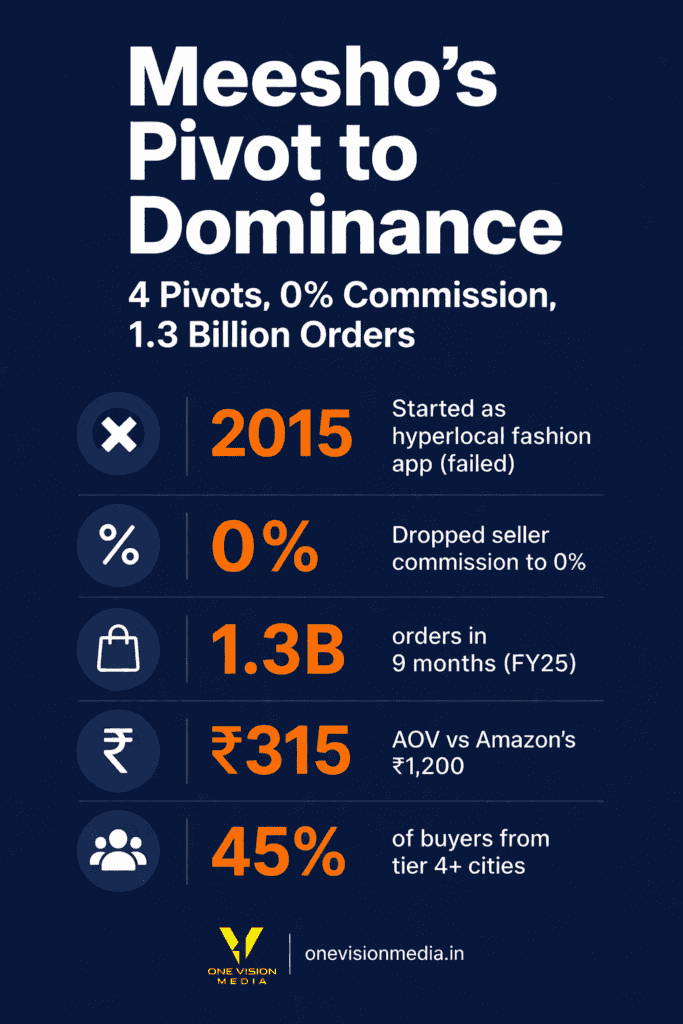
Infographics Of How – Meesho’s Pivot to Indian Retail Dominance
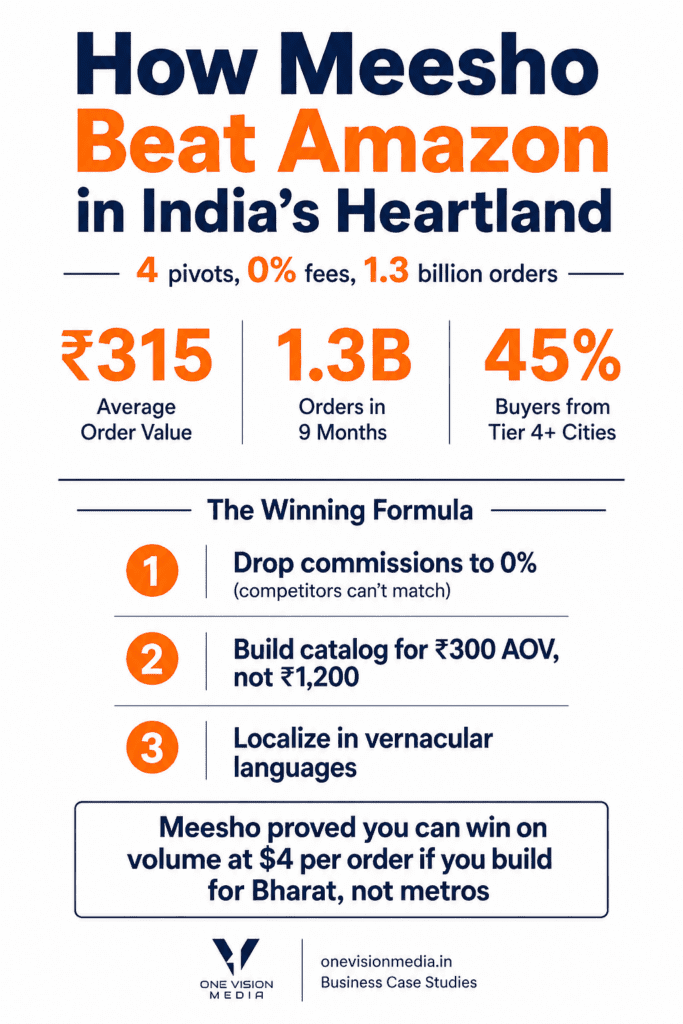
Infographic How Meesho beats Amazon in India heartland
Frequently Asked Questions
Q: What is the Meesho business model and how does it make money without charging seller commissions?
A: Meesho operates a zero-commission e-commerce marketplace that monetizes through logistics fees (charged per delivery), advertising revenue (promoted listings and seller ads), and value-added services like working capital products for sellers. Unlike Amazon and Flipkart, which charge 2-15% commissions per transaction, Meesho keeps seller fees at 0% and instead earns ₹20-30 per order through delivery charges and ad placements, generating ₹9,390 crore revenue in FY25 while operating near break-even.
Q: How did Meesho succeed after multiple pivots when most startups fail after one?
A: Meesho succeeded because each pivot addressed a structural constraint rather than a temporary setback. Starting as a hyperlocal fashion app in 2015, it pivoted to social reselling in 2016 when offline inventory proved unreliable, then to a full marketplace by 2019 as social distribution capped growth, and finally to zero-commission in July 2021 to differentiate from Amazon and Flipkart’s commission-heavy models. The key lesson: pivot toward an advantage competitors can’t replicate, not just away from failure.
Q: Why does Meesho dominate tier 2, 3, and 4 cities while Amazon and Flipkart struggle there?
A: Meesho wins in tier 2-3-4 cities because it matches product selection, pricing, and delivery expectations to local reality rather than trying to replicate the metro playbook. With an average order value of just ₹315-₹350 (vs Amazon’s ₹800-₹1,200), vernacular language interfaces, and a catalog of 140M+ unbranded affordable products, Meesho serves the purchasing power and preferences of India’s next 500 million internet users. About 45% of Meesho’s festive-sale buyers come from tier 4 cities and beyond, where Amazon’s premium-brand focus and English-first interface create barriers.
Q: Is Meesho profitable yet, and when will it reach full profitability?
A: Meesho is not yet fully profitable but is near break-even on core operations. In FY25, it posted ₹9,390 crore revenue against a ₹3,941 crore net loss, but the core operational loss was only ₹108 crore after stripping out exceptional items. Analysts expect Meesho to reach GAAP profitability by 2027-2028 if order volume continues growing 30-40% annually and logistics margins improve through AI-driven routing and scale economies with courier partners.
Q: What are the biggest risks Meesho faces in the next 12-24 months?
A: Meesho faces four major risks: (1) high return rates (20-30% in fashion) destroying unit economics if quality control doesn’t improve, (2) Amazon or Flipkart launching zero-commission verticals to match Meesho’s pricing advantage, (3) quick commerce and Instagram-based social selling fragmenting tier 2-3 buyers, and (4) tightening Indian e-commerce FDI regulations forcing costly marketplace restructuring. If any of these materialize, Meesho’s path to profitability extends beyond 2028, jeopardizing its $4-5 billion IPO valuation target.
Q: Can an Indian founder replicate Meesho’s tier 2-3 strategy in other verticals like healthcare or education?
A: Yes, but only if you solve for tier 2-3 structural constraints rather than adapting metro solutions. Meesho succeeded by matching catalog (unbranded, affordable products), pricing (₹315 AOV), language (vernacular UI), and logistics (1-3 day delivery that actually works) to ground reality in smaller cities. For healthcare, this might mean telemedicine in regional languages with ₹100-200 consultation fees and medicine delivery partnerships in tier 3 towns. For education, it’s pre-recorded vernacular courses priced at ₹500-1,000 instead of ₹5,000-10,000 live classes targeting metros. The pattern: don’t “educate” tier 2-3 users to behave like metro users—build for them as they are.
Q: How does Meesho compare to Flipkart and Amazon in terms of seller experience and marketplace fees?
A: Meesho charges 0% seller commission vs Flipkart’s ₹100-120 per order marketplace fee and Amazon’s 2-15% category-based commissions. This makes Meesho attractive for small sellers and unbranded product categories where margins are already thin. However, Amazon and Flipkart offer better logistics infrastructure (faster delivery, lower return rates), larger premium customer bases, and more robust seller tools for inventory management and analytics. For a seller with branded products targeting metros, Amazon/Flipkart deliver higher order values; for a seller with ₹200-500 unbranded goods targeting tier 3 cities, Meesho’s zero-commission and high order volume make it the better choice.
Q: What lessons can founders learn from Meesho’s pivot strategy that apply to their own startups?
A: The core lesson from Meesho pivots is to pivot toward a structural advantage, not just away from failure. Each of Meesho’s four pivots (hyperlocal → social → marketplace → zero-commission → Meesho Mall) addressed a constraint that competitors either couldn’t or wouldn’t solve. Ask: what immovable assumption does my industry accept that I can reject? For Meesho, it was “marketplaces must charge commission.” For your startup, it might be “SaaS must be per-seat priced” or “fintech must partner with banks.” Find the structural constraint everyone accepts, build around it, and you create a moat competitors can’t copy without blowing up their own model.