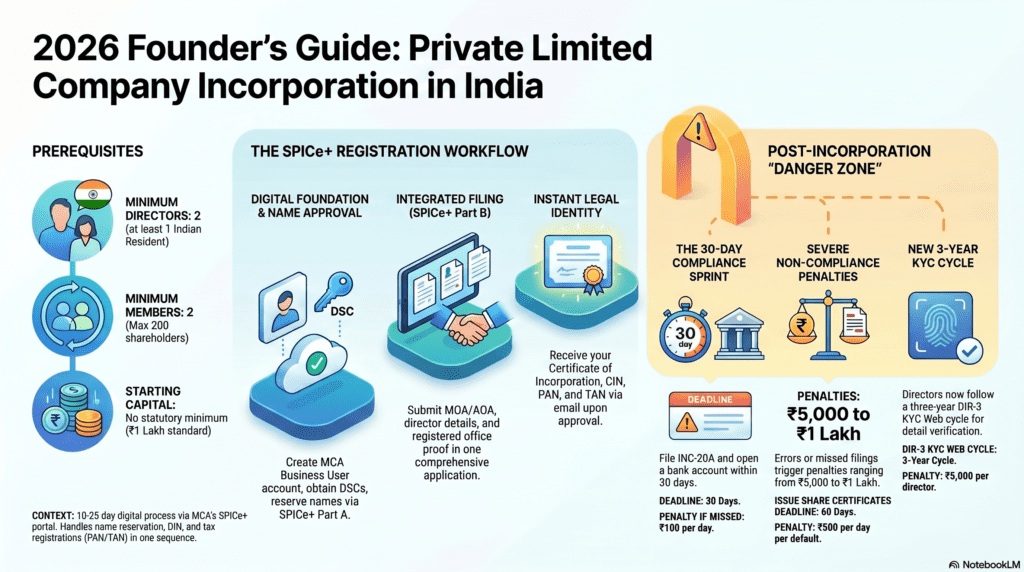
A well-prepared private limited company incorporation in India usually takes about 10-25 working days, depending on document readiness, name approval, and ROC processing. The process is entirely digital through the Ministry of Corporate Affairs (MCA) portal using the SPICe+ integrated workflow. There is no statutory minimum paid-up capital requirement, though founders often choose an authorized capital of ₹1 lakh or more for practical reasons. Critical compliance errors in post-incorporation filings trigger penalties from ₹5,000 to ₹1 lakh in the first year.
Most founders make one critical mistake: they treat incorporation as a one‑time form‑filling exercise, not a compliance foundation. The errors in the MOA, registered‑office proof, and initial director filings may seem small at first, but they snowball into repeated amendments, avoided investment, and reputational risk over the next three years.
What You’re Actually Signing Up For: Requirements For Registering a Pvt. Company in India
Before you start the MCA portal process, understand the non-negotiable requirements under the Companies Act, 2013:
| Requirement | Specification | Why It Matters |
| Minimum Directors | 2 directors minimum (maximum 15 without special approval) | Can be the same as shareholders; relatives allowed |
| Indian Resident Director | At least 1 director must be resident in India | Resident = person who stayed in India for 182+ days in previous calendar year |
| Minimum Members | 2 members minimum (maximum 200) | Members are shareholders; can overlap with directors |
| Minimum Capital | No statutory minimum paid-up capital requirement | Founders often choose ₹1 lakh or more authorized capital for practical reasons |
| Age Requirement | Directors must be 18+ years | Verified via government ID documents |
| DIN & DSC | All directors need Director Identification Number and Digital Signature Certificate | Essential for filing any MCA forms digitally |
| Registered Office | Physical address with proof (utility bill + NOC if rented) | Cannot be P.O. Box; residential address is allowed |
Capital reality check: There is no statutory minimum paid-up capital requirement for a private limited company. You can legally register with ₹1,000 paid-up capital. However, most banks require minimum ₹25,000-₹50,000 for opening a current account, and enterprise clients may view very low capital as a red flag. Practical starting point: ₹1 lakh authorized capital (determines stamp duty) and ₹50,000-₹1 lakh paid-up capital (actual investment).
i have made some mistake that cost me ₹2.3 Lakh last year while registering a business, i have write a detailed article on that so you can avoid that mistake How to Register a Business in India – 2026 Guide to Avoid ₹2.3 Lakh Mistakes
Understanding the MCA Portal and SPICe+ Workflow
The Ministry of Corporate Affairs (MCA) portal at mca.gov.in is India’s centralized system for all corporate registrations and filings.
What SPICe+ Actually Does
SPICe+ is the MCA’s integrated incorporation workflow covering incorporation, DIN, PAN, TAN, EPFO, ESIC, profession tax, and bank account opening, with GST and Shops/Establishment links where applicable. Before SPICe+ existed, founders filed 6-8 separate forms across multiple govt portals. Now it’s a single workflow that connects everything.
SPICe+ has two parts:
- Part A: Name reservation (with DIN application if needed)
- Part B: Actual incorporation filing with MOA/AOA attachment
Timeline reality: Name approval under SPICe+ is generally valid for 20 days for new incorporation. If you don’t file Part B within 20 days of name approval, the approval expires and you start over.
Who Qualifies: Director and Member Rules
Directors:
- A private limited company must have at least 2 directors
- At least 1 director must be resident in India
- Maximum 15 directors without special resolution
- Directors can be shareholders (common in small companies)
Members (Shareholders):
- A private limited company must have at least 2 members and can have up to 200 members
- Members can be individuals or corporate entities
- Members and directors can be the same people (standard for founder-led startups)
Foreign nationals: Can be directors or shareholders. However, the “at least 1 resident Indian director” rule still applies. Foreign directors need additional documentation (notarized passport, address proof from home country).
The Three Document Pillars You Cannot Skip
Memorandum of Association (MOA)
The company’s “constitution” that defines objectives, registered office state, authorized capital, and subscriber details. This is a public document filed with MCA and available for anyone to view.
Critical clause: Object Clause (Clause 3)
This lists all business activities your company can legally undertake. If you later want to do something not covered in your MOA, you’ll need to file an amendment form, hold board and shareholder meetings, pay govt fees, and wait for ROC approval. Timeline: 45-60 days. Cost: approx ₹15,000-₹35,000 depending on CA charges.
Strategic approach: Include 3-5 broad object clauses covering your current business plus logical adjacent activities. Example for a software company:
- Software development and IT consulting services
- Design, development, and licensing of software products
- Cloud computing and data services
- Digital platform operations
- Technology research and development
Articles of Association (AOA)
The company’s internal rulebook covering board meetings, shareholder rights, share transfers, dividend policy, and director powers. Also a public document.
MCA provides standard AOA templates that work for most companies. You only need custom AOA if you’re planning:
- Employee stock option schemes (ESOPs)
- Founder vesting schedules
- Special share classes (preference shares)
- Custom voting rights or board structures
Incorporation Document Bundle
- DIN applications for all directors
- Declaration by professionals (CA/CS) or directors
- Registered office proof (utility bill + rent agreement or ownership deed + landlord NOC)
- Identity proof (Aadhaar + PAN for all directors and subscribers)
- Address proof for directors (bank statement/passport/voter ID)
The 7-Step MCA Portal Registration Process
Step 1: Create MCA User Account
Visit www.mca.gov.in and create a Business User account (not “Registered User” which is view-only).
Process:
- Click “MCA Services” → “Register as New User”
- Select “Business User”
- Provide: Name, email, mobile, PAN
- Verify email via OTP
- Upload Digital Signature Certificate (DSC)
Timeline: 15 minutes
Common mistake: Creating a “Registered User” account instead of “Business User” account. Registered users cannot file incorporation forms.
Step 2: Obtain Digital Signature Certificate (DSC)
DSC is mandatory for both directors to digitally sign MCA forms. You cannot file SPICe+ without it.
Where to get DSC:
- Licensed Certifying Authorities: eMudhra, Sify, nCode Solutions, Capricorn CA
- Timeline: 2-3 days for physical USB token delivery
- DSC validity: typically 2 years
Process:
- Visit certifying authority website
- Select DSC for company registration
- Submit: PAN card, Aadhaar, passport photo, address proof
- Complete video KYC
- Pay fee online
- Receive USB token via courier
Important: Keep your DSC USB token safe. Losing it means repurchasing a new one. The DSC is personal to each director and cannot be shared.
Step 3: Apply for Director Identification Number (DIN)
DIN is a unique 8-digit identification for every company director. Since 2020, DIN application is integrated into SPICe+ Part A.
Who needs DIN:
- Every proposed director (including nominee directors)
- Foreign directors (requires additional documentation)
Process:
- Login to MCA portal with DSC
- Navigate to “MCA Services” → “SPICe+” → “Part A”
- Fill director details: Name, Father’s Name, DOB, PAN, Aadhaar, Address
- Upload: PAN card copy, address proof, passport-size photo
- Submit with DSC signature
Timeline: 1-2 days after submission
Step 4: Reserve Company Name
Company name approval is often the most delayed step due to rejections for similarity or guideline violations.
Name Rules (Companies Act 2013):
- Must be unique (not identical or too similar to existing companies)
- Cannot suggest govt patronage (“National,” “Government,” “India” require justification)
- Cannot contain vulgar or offensive words
- Cannot violate trademark rights (check IP India database first)
SPICe+ Part A Filing:
- Login to MCA portal
- File “SPICe+ Part A (RUN – Reserve Unique Name)”
- Propose 2 names in order of preference
- Select company category: “Company Limited by Shares” → “Private”
- Choose main business activity (NIC code)
- Submit with DSC
Timeline: 2-4 working days for approval
Resubmission: If rejected, you get 1 free resubmission within the same application. If that’s also rejected, you file a new application.
Post-approval: Approved name is valid for 20 days. You must file SPICe+ Part B (incorporation) within this window, or the name expires.
Step 5: Draft MOA and AOA
Once name is approved, prepare Memorandum and Articles of Association.
Option 1: Use MCA’s Electronic Templates (Free)
MCA provides pre-approved electronic templates (eMOA and eAOA) accessible via SPICe+ Part B. These auto-fill based on your company details.
When templates work:
- Simple share structure (all equity shares)
- Standard 2-director setup
- No employee stock options planned
- No custom voting rights needed
Option 2: Custom MOA/AOA via CA
Hire a Chartered Accountant or Company Secretary if you need:
- Comprehensive object clauses (future-proof for pivots)
- ESOP provisions
- Founder vesting schedules
- Custom governance structures
The costly mistake many founders make: Using a narrow object clause to save time. Example: A founder registers with “software development services” as the sole object. Later, when launching a SaaS product (which falls under “software licensing” not “development”), the client’s legal team flags it. Result: forced MOA amendment via board resolution, EGM, and ROC filing. Timeline: 45-60 days. Cost: approx ₹20,000-₹40,000.
Step 6: File SPICe+ Part B (Incorporation Form)
This is the main incorporation application.
SPICe+ Part B Components:
- Company name (auto-filled from Part A approval)
- Director details (DIN, DSC, address proof)
- Subscriber details (shareholders; can be same as directors)
- Registered office address (requires utility bill + rent agreement or ownership deed + landlord NOC)
- Authorized capital (determines stamp duty)
- Paid-up capital (actual investment)
- Attachment of eMOA and eAOA
- Declaration by professional (CA/CS) or director
Government fees: Vary by state and authorized capital amount. Generally:
- Stamp duty: ₹200-₹2,000 depending on state and capital
- Filing fee: ₹200
- State-specific charges apply
Timeline: Submit form, pay fees, digitally sign with both directors’ DSC. ROC processing takes 7-10 working days if no queries raised.
Step 7: Receive Certificate of Incorporation
If your application is complete and compliant, the Registrar of Companies (ROC) issues:
- Certificate of Incorporation (COI) — the company’s legal birth certificate
- Corporate Identity Number (CIN) — unique 21-character company ID
- PAN — auto-issued by Income Tax Department
- TAN — for TDS filing
All documents arrive via email.
What to verify immediately:
- Company name spelling
- CIN accuracy
- Directors’ names match PAN/Aadhaar exactly
- Registered office address is complete with PIN code
Post-Incorporation Compliance: The 30-Day Danger Zone
Your company is legally registered, but several mandatory filings must be completed to avoid penalties:
| Action | Form/Process | Deadline | Penalty if Missed |
|---|---|---|---|
| File INC-20A | Registered office address verification | Within 30 days of COI | ₹100/day |
| Open Bank Account | Current account with COI, MOA, AOA, PAN | Within 30 days recommended | Operations blocked; can’t receive funds |
| Issue Share Certificates | Physical share certificates for subscribers | Within 60 days | ₹500/day per default |
| File DIR-3 KYC Web | Director KYC verification | Three-year cycle with event-based updates | ₹5,000 per director + DIN deactivation risk |
| Hold First Board Meeting | Appoint auditor, fix registered office, authorize bank account | Within 30 days | Compliance violations |
| Apply for GST (if required) | If turnover expected > ₹40 lakhs or interstate sales | Within 30 days of threshold breach | ₹200/day |
Most forgotten: INC-20A and first board meeting. Many new companies skip these and face penalties during first annual filing.
Critical Compliance Update: DIR-3 KYC Changes
Old system (pre-2026): Directors filed DIR-3 KYC annually by 30th September every year.
New system (2026 onwards): As per the 2026 MCA update material, DIN holders now follow a three-year DIR-3 KYC Web cycle with event-based updates within 30 days of changes in key details.
What this means:
- You file DIR-3 KYC Web once every three years (not annually)
- If any key details change (address, email, mobile, designation), you must update within 30 days via DIR-3 KYC Web
- Failure to comply triggers ₹5,000 penalty per director and potential DIN deactivation
How to file DIR-3 KYC Web:
- Login to MCA portal
- Navigate to DIR-3 KYC Web form
- Enter DIN, PAN, Aadhaar number
- Verify OTP on Aadhaar-linked mobile
- Update any changed information
- Digitally sign with DSC
Real Founder Mistakes That Trigger Penalties
Mistake #1: Rushing Through the MOA Object Clause
What happened to me: In 2025, I registered my company using the standard eMOA template with a single object clause focused on “software development services.” The filing went smoothly and we got our COI in 18 days.
Eight months later, we pivoted from client services to launching our own SaaS product. When signing an enterprise contract, the client’s legal team reviewed our MOA and flagged that “software licensing” and “cloud-based services” weren’t covered in our object clause.
The fix required:
- Filing a board resolution
- Calling an Extraordinary General Meeting (EGM) with shareholders
- Filing the appropriate amendment form with MCA
- Paying govt fees and CA charges
- Waiting 45 days for ROC approval
- Delayed client onboarding during this period
Total cost: Approx ₹30,000-₹40,000 in professional fees and govt charges, plus opportunity cost of delayed revenue.
Prevention: Spend time upfront (or hire a CA) to draft comprehensive object clauses covering your current business model plus 2-3 logical adjacent activities. The MOA is permanent unless amended, so think ahead.
Mistake #2: Ignoring Registered Office Proof Requirements
Common scenario: Founder uses home address as registered office but uploads utility bill in parent’s name (property owner). MCA rejects application for “invalid address proof.”
What you actually need:
- Latest utility bill (electricity/water/gas) in owner’s name (not older than 2 months)
- Ownership deed or sale agreement
- No Objection Certificate (NOC) from property owner stating they permit business registration at that address
- If renting: rent agreement + landlord’s NOC + landlord’s property documents
Cost of error: Resubmission delays of 7-10 days, plus potential name expiry if you’re near the 20-day deadline.
Mistake #3: Not Linking Aadhaar with DIN
Since 2023, MCA mandates Aadhaar-DIN linking for all directors. The DIR-3 KYC Web process includes this verification.
The problem: Some founders complete incorporation but forget to maintain their DIR-3 KYC cycle. Under the new three-year system, if you skip an update cycle or fail to update within 30 days of a key detail change, your DIN can be deactivated.
What DIN deactivation means:
- Company cannot file annual returns
- Cannot add or remove directors
- Cannot make changes to company details
- Compliance status becomes “non-compliant”
- Penalty: ₹5,000 per director
How to verify Aadhaar-DIN linking:
- Login to MCA portal
- Check your DIN status
- If not linked, file DIR-3 KYC Web immediately
- Set calendar reminders for your three-year cycle
Forecast & Strategic Outlook: MCA Process Changes 2026-2027
Expected Timeline Improvements
MCA continues digitizing and streamlining processes. Based on current trends:
Name approval: Real-time name availability checking is being piloted. May reduce approval time from 2-4 days to same-day in late 2026.
ROC processing: States with lighter workload (Karnataka, Telangana) already process incorporations in 7-10 days. High-volume states (Maharashtra, Delhi) average 12-18 days. Expect convergence toward 10-day standard by 2027.
Integrated services: SPICe+ already covers multiple registrations. Future upgrades may include direct MSME Udyam registration and startup recognition within the same workflow.
Compliance Automation Growing
More founders are using compliance platforms (Zoho Books, ClearTax, Vakilsearch) for automated filing reminders and form generation. By 2027, expect MCA to launch APIs allowing real-time compliance tracking and penalty alerts.
Policy Shifts to Watch
Angel tax abolition impact: With Section 56(2)(viib) removed in Budget 2025, early-stage funding into Pvt Ltd startups has increased. More first-time founders are choosing Pvt Ltd over Proprietorship from day one to stay investor-ready.
DIR-3 KYC enforcement: The shift from annual to three-year cycle reduces compliance burden, but penalties for non-compliance remain strict. Expect stricter DIN deactivation enforcement in 2026-2027 as MCA cleans up dormant director records.
Methodology & References
This article is based on:
- MCA Portal documentation (www.mca.gov.in): Official SPICe+ guidelines, Companies Act 2013 rules, and circulars on DIR-3 KYC updates as of 2026
- Primary research: Step-by-step walkthrough of actual SPICe+ filing process on MCA portal (conducted March 2026)
- Personal documentation: My own company incorporation records from 2025, including MOA amendment process, invoices, and MCA correspondence
- CA consultation: Interviews with practicing Chartered Accountants on common incorporation errors and their cost implications
- Government sources: Ministry of Corporate Affairs circulars, Income Tax Department PAN/TAN integration guidelines, Companies Act 2013 statutory requirements
- Industry sources: Corporate law practitioner insights on post-incorporation compliance patterns and penalty trends
All timelines, requirements, and compliance rules verified as of April 2026. Cost estimates based on real founder experiences and CA fee structures, not official MCA data.
Frequently Asked Questions
Q: How long does it actually take to register a Private Limited Company in India in 2026?
A: A well-prepared private limited company incorporation in India usually takes about 10-25 working days, depending on document readiness, name approval, and ROC processing. The timeline breaks down as: 2-3 days for DSC procurement, 1-2 days for DIN application, 2-4 days for name approval via SPICe+ Part A, 7-10 days for incorporation approval after filing SPICe+ Part B, and 1-2 days for PAN/TAN issuance. The biggest variable is document completeness; if your registered office NOC or director address proofs need corrections, add another 5-7 days.
Q: Can I register a Private Limited Company without hiring a Chartered Accountant?
A: Yes, you can legally register through the MCA portal yourself; it’s designed for self-service. The SPICe+ form provides electronic MOA/AOA templates that work for standard companies. However, the MOA’s object clause is permanent unless amended (which costs ₹20,000-₹40,000 and takes 45-60 days). Many founders save CA fees upfront but pay multiples of that amount later when their narrow object clause blocks a client contract or investor deal. If your business is simple (single service, no funding plans, standard shareholding), DIY works. If you plan to scale, pivot, or raise money, a CA’s guidance on future-proof object clauses is worth the investment.
Q: What is SPICe+ and why does it matter for company registration?
A: SPICe+ is the MCA’s integrated incorporation workflow covering incorporation, DIN, PAN, TAN, EPFO, ESIC, profession tax, and bank account opening, with GST and Shops/Establishment links where applicable. Before SPICe+ existed, founders filed 6-8 separate forms across different govt portals over 30-45 days. SPICe+ compressed this into a single workflow that takes 10-25 days end-to-end. Part A handles name reservation and DIN application, Part B handles actual incorporation with MOA/AOA attachment, and linked forms auto-populate based on your inputs. It’s the only way to incorporate a company in India as of 2026.
Q: Do both directors need to be physically present in India during company registration?
A: No, physical presence is not required; the entire process is digital. However, at least 1 director must be resident in India (someone who spent 182+ days in India in the previous calendar year). This resident director needs a valid Indian address, Aadhaar card, and Indian mobile number for OTP verification. The second director can be a foreign national living abroad, but they need notarized passport, apostilled address proof from their home country, and must obtain a DIN through the MCA portal. Both directors must have Digital Signature Certificates to sign forms electronically.
Q: What is the minimum capital required to start a Private Limited Company in India?
A: There is no statutory minimum paid-up capital requirement for a private limited company under the Companies Act 2013. You can technically register with ₹1,000 paid-up capital. However, you must declare an authorized capital in your MOA (most founders choose ₹1 lakh or more for practical reasons), which determines govt stamp duty. Banks typically require ₹25,000-₹50,000 minimum balance for opening a current account, and enterprise clients may view very low capital as a credibility issue. Practical starting point: ₹1 lakh authorized capital and ₹50,000-₹1 lakh paid-up capital.
Q: What happens if MCA rejects my company name during SPICe+ Part A filing?
A: If your proposed name is rejected, MCA sends a rejection notice within 2-4 days citing the reason: similarity to existing company, trademark conflict, prohibited words, or guideline violations. You get one free resubmission to propose alternate names within the same SPICe+ Part A application. If the resubmission is also rejected, your application expires and you must file a completely new SPICe+ Part A with fresh payment. To avoid rejection: (1) Check name availability on MCA Master Data portal before filing, (2) Search IP India trademark database at ipindiaonline.gov.in, (3) Avoid generic words like “India,” “National,” or category descriptors like “Tech Solutions.”
Q: What’s the difference between authorized capital and paid-up capital for registration purposes?
A: Authorized capital is the maximum share value your company can issue as per its MOA (e.g., ₹1 lakh authorized means you can issue shares worth up to ₹1 lakh total). Paid-up capital is what shareholders have actually contributed (e.g., ₹50,000 paid-up means founders invested ₹50,000). For MCA registration, govt stamp duty is calculated on authorized capital, not paid-up capital. So declaring ₹10 lakh authorized triggers higher fees than ₹1 lakh, even if you only contribute ₹10,000 initially. Most startups start with ₹1 lakh authorized and ₹50,000 paid-up, which keeps fees minimal while maintaining flexibility to increase capital later when raising funds.
Q: Can I use my home address as the registered office, or do I need commercial space?
A: You can absolutely use your residential home address as the registered office; there’s no legal requirement for commercial property. You need: (1) utility bill in property owner’s name (not older than 2 months), (2) ownership deed or rent agreement, and (3) No Objection Certificate (NOC) from the property owner stating they permit business registration at that address. The NOC should be notarized to avoid MCA queries. Virtual offices and co-working spaces are also allowed if the provider gives you proper lease agreement and NOC. Note: Some banks reject virtual office addresses for current account opening, so verify with your bank first. Changing registered office later requires filing the appropriate form within 15 days of change.






Really helpful for anyone planning to start a company. Thanks for sharing.
Thanks, it always fills me with joy when my articles help someone.
I was looking forward to open a PVT firm and this article has helped me alot in that.
Nice work team, keep it up 👍
thanks appreciate it
I was looking forward to open a PVT firm and this article has helped me alot in that.
Nice work team, keep it up 👍
This is such a thorough and well researched article on the steps of Opening a PVT. Might be bit lengthy but better to be educated on these things. Thank you 🙏🏻
I’ll try to make a short and concise version or in a quick step guide but in short version may not able to provide all the details thanks for the appreciation