After years of regulatory hurdles, card tokenization overhauls, and intense industry speculation, Apple Pay has officially launched in India today.
While domestic UPI giants like PhonePe, Paytm, and Google Pay heavily dominate high-volume, low-ticket transactions across india, Apple’s entry can change things. Apple Pay targets an entirely different segment: India’s high-spending, premium iOS demographic.
Below is the complete strategic breakdown of Apple Pay’s India launch, what it means for your payment infrastructure, and how you can implement it today.
My Personal POV on Apple Pay
Now, the above claim that Apple is targeting high-spending, premium iOS users is something an official spokesperson would say. However, in India, we all know that more than 70–80% of iPhone sales happen via EMIs.
So, claiming that Apple Pay will consist solely of high-spending users isn’t entirely accurate. Those who buy iPhones on EMI merely to show off to their peers are unlikely to use Apple Pay frequently, and even if they do, you can expect a very low transaction volume from them.
Now, I’m not saying that all of those 70–80% of users are doing it to show off, but a solid 50% of them certainly are.
Apple Pay India Launch: Overview, Tech Architecture, and Why It Took a Decade
Apple Pay first launched in US on October 20, 2014 and within 8 months they were in UK. Then after that by 2016 they were in all major countries like Australia, China, Singapore, Japan so why did it take 11-12 years (11 years, 11 months 10 days) to launch in India?
Why Apple Pay Took Over a Decade to Launch in India
- Biometric 2FA Regulations: The Reserve Bank of India (RBI) long required SMS OTPs or bank PINs for digital payments, conflicting with Apple’s one-touch Face ID experience. The rollout only became viable once updated RBI guidelines formally treated device possession plus biometrics as valid two-factor authentication.
- Data Localization Directives: The RBI’s 2018 mandate required all payment logs and customer data to reside exclusively on domestic servers. Aligning Apple’s globally distributed tokenization systems with local data residency laws required years of complex re-engineering.
- The Dominance of UPI: Shortly after Apple Pay debuted globally, UPI transformed India into a zero-cost, QR-code-driven digital economy. This instant bank-to-bank rail left little initial consumer demand for an NFC-dependent card wallet.
- Contactless POS Infrastructure: Apple Pay requires NFC tap-and-pay merchant machines, which were virtually non-existent across Indian retail a decade ago. It took years for payment aggregators and banks to deploy the millions of contactless terminals operating today.
- Commercial and Banking Alignments: Indian banks operate on tight payment margins and hesitated to pay Apple’s standard transaction fees. Reaching mutually viable terms delayed partnerships, leading to a selective rollout starting with Axis Bank credit cards.
By launching through card tokenization rather than head-to-head UPI competition, Apple chose a focused entry aimed squarely at India’s premium credit card users..
Apple Pay India Partnerships: Supported Banks, Card Networks, and Payment Gateways
“India is home to a dynamic and digitally savvy population that continues to embrace a cashless future while expecting the highest standards of security and privacy, and we’re so excited to bring Apple Pay to users in India today,”
– Jennifer Bailey
While Apple has not officially disclosed why it selected Axis Bank as its initial launch partner over rivals like HDFC Bank and ICICI Bank, reports from Reuters and Moneycontrol indicate that technical readiness was the primary factor behind the timeline. However, industry observers suggest that commercial disagreements over interchange fee revenue also played a role. Moneycontrol further clarified that the Axis Bank arrangement is non-exclusive, framing the launch as the first phase of a broader commercial rollout across Indian banks.
Apple Pay Supported Banks and Cards in India
Apple Pay is currently exclusive to Axis Bank-issued Visa and Mastercard credit cards. Debit cards, RuPay cards, corporate commercial lines, and credit cards issued by other domestic private or public sector banks are not supported in this initial rollout phase.
Apple Pay Integrated Aggregators & Payment Gateways in India
Merchants do not need direct bilateral agreements with Apple to accept payments. Infrastructure aggregators and payment gateways have activated Apple Pay acceptance across point-of-sale (POS) contactless terminals and digital checkouts:
- Online & In-App Aggregators: Razorpay, Cashfree Payments, Juspay, PayU, and Paytm Payment Gateway.
- Offline POS & Terminal Providers: Pine Labs, Mswipe, and Worldline India.
- Launch Merchants: Integrated platforms include Blinkit, Zomato, Croma, Tata 1mg, Ixigo, Reliance Retail outlets, and official Apple retail locations.
Apple Pay Supported Countries List
Today after India Launch Apple Pay is now available in more than 90 countries and regions, and works with more than 11,000 bank and network partners worldwide.
The exact global breakdown
- Europe: 58 countries and territories (including the UK, France, Germany, Spain, and Italy)
- Latin America & the Caribbean: 16 countries and territories (including Brazil, Mexico, Argentina, and Colombia)
- Asia-Pacific: 14 countries and territories (including Australia, Mainland China, Japan, Singapore, South Korea, and the Philippines)
- Middle East: 10 countries and territories (including the United Arab Emirates, Saudi Arabia, Israel, and recently India)
- Africa: 4 countries (Egypt, Mauritius, Morocco, and South Africa)
- North America: Canada, the United States, and Puerto Rico
How Apple Pay Works
Apple Pay is designed to make transactions private and secure by keeping actual card credentials off merchant databases and device storage.
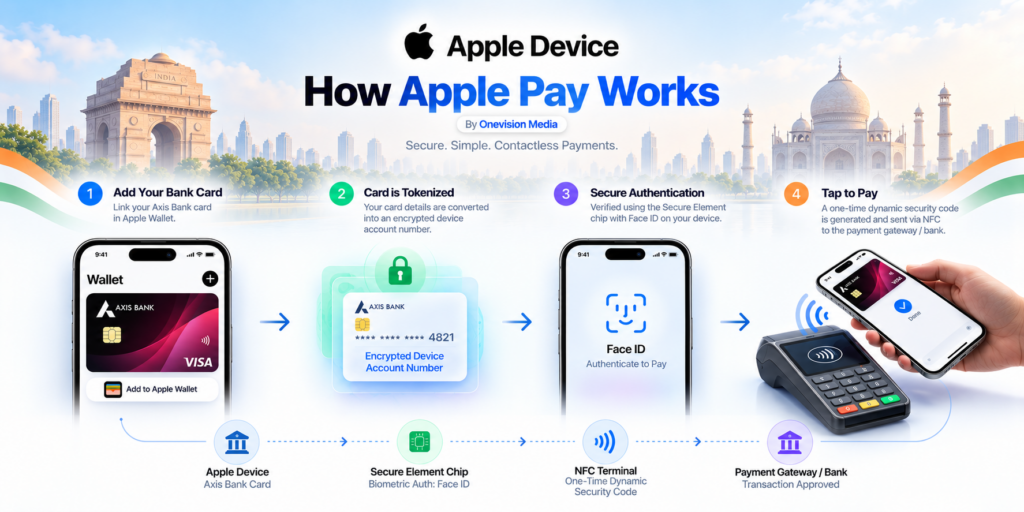
How the Apple Pay App Processes Secure Transactions
- Hardware-Level Security: When a transaction is initiated, the device transmits the Device Account Number alongside a transaction-specific, dynamic security cryptogram over NFC or secure web APIs. The user’s actual 16-digit card number is never shared with the merchant or transmitted to Apple servers.
- Zero-Friction Authentication: Physical retail payments require double-clicking the side or Home button, authenticating via Face ID, Touch ID, or passcode, and resting the device against an NFC-enabled POS terminal. No additional debit PIN or SMS-based OTP is requested at the counter.
Frequently Asked Questions (FAQ)
No. At launch, Apple Pay works exclusively with tokenized Visa and Mastercard credit cards. It does not support UPI rails, NPCI MPIN verification, or RuPay-network cards.
Axis Bank is Apple’s exclusive rollout partner in India. Major issuers like HDFC, ICICI, and SBI Card held back over commercial terms—chiefly Apple’s per-transaction interchange fee—though additional banks are planned for future phases.
It is supported on Safari and iOS apps via aggregators like Razorpay, Cashfree, Juspay, and PayU. Launch platforms include Zomato, Blinkit, Croma, Tata 1mg, Ixigo, Chaayos, Le15 Patisserie, Reliance brand stores, and the official Apple India Newsroom
announcement.
Apple charges zero additional processing fees to merchants. Businesses simply pay their standard contracted Merchant Discount Rate (MDR) for regular Visa or Mastercard credit card transactions through their existing gateway.
If you want to build your own business like apple read our 9 Books on Reading Financial Statements Every Founder Must Read to full proof your business finances