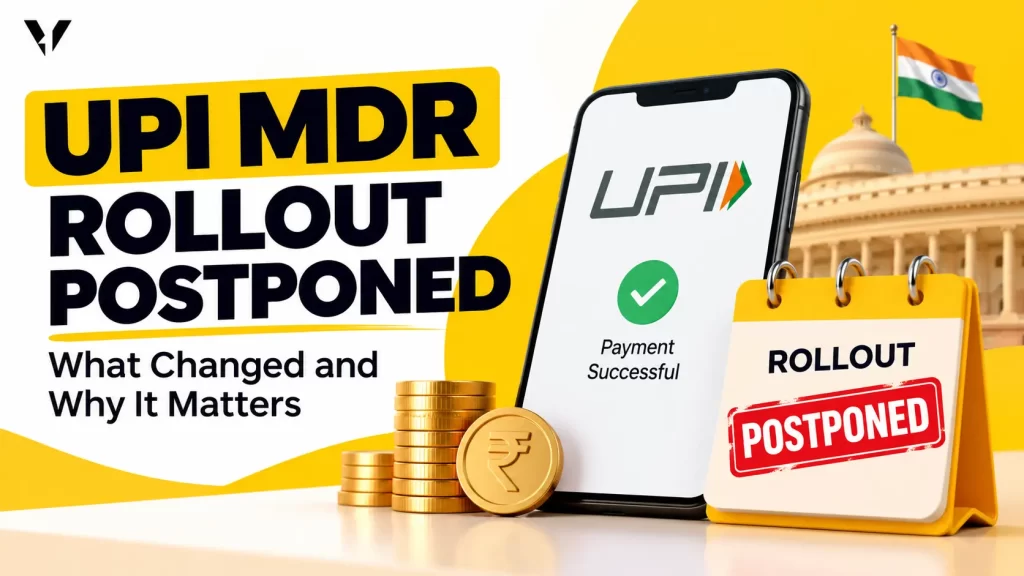
Good news for business owners: MDR is postponed.
The National Payments Corporation of India (NPCI) has postponed the rollout of Merchant Discount Rate (MDR). The charges were originally set to begin on October 15, 2026, but will now be implemented immediately after Diwali; the exact date is not confirmed, but NPCI will notify soon.
What Is MDR? Full Form, Function, and Who Pays
MDR stands for Merchant Discount Rate, so what are these merchant discount rate charges?
MDR is a fee that shopkeepers (merchants) pay when processing digital payments.
Suppose you go to buy a phone, you buy your phone worth Rs. 20,000/- and then you do your payment using UPI. After receiving the payment, the merchant has to pay 0.40% of the total transaction to NPCI (Rs. 20,000/ – 0.40% = Rs. 80/-). Customers will NOT have to pay any fee.
Under the proposed rules:
- Transactions above ₹2,000: Will have a 0.40% fee (capped at a maximum of ₹300).
- Bills, Utilities, Fuel, and Education: Will have a flat fee of ₹5 for payments above ₹2,000.
- Exemptions: Payments under ₹2,000 and personal transfers (P2P) will remain 100% free.
Now you understand the charges and all now Let’s see some numbers
UPI Transection Last Year
The Volume Numbers Explained (FY 2025–26)
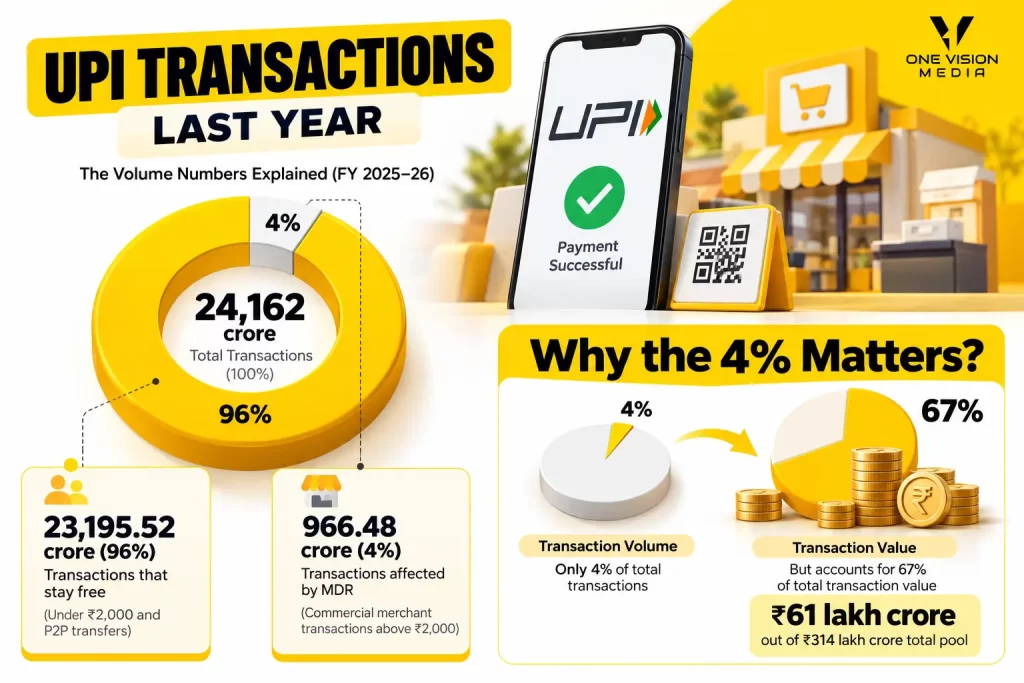
If we calculate these percentages based on the total annual volume of 24,162 crore transactions reported by PIB(Press Information Bureau) & INDmoney:
- Total Annual Transactions: 24,162 crore (100%)
- Transactions that stay free (96%): 23,195.52 crore (These are transactions under ₹2,000 and P2P transfers)
- Transactions affected by MDR (4%): 966.48 crore (Commercial merchant transactions above ₹2,000)
Why the 4% Matters ?
While the 4% sounds like a small volume of transactions, it represents a massive portion of the monetary value. According to Dataful and Factly.in, 4%% of high-value merchant payments account for roughly 67% (two-thirds) of the total transaction value, translating to approximately ₹61 lakh crore out of the year’s ₹314 lakh crore total pool
Where Will the MDR Revenue Go?
According to government figures, about 96% of merchant UPI transactions will stay free, affecting only about 4% of total payments.
The money collected from those 4% of the fee will be shared among banks, payment apps, and service providers to help maintain and improve the UPI payment network.
Why Are Retailers and Trade Associations Protesting?
Following the MDR announcement On September 15, 2026, both business owners and regular users are dissatisfied, each with their own reasons
Retail trader groups are unhappy because many shops operate on very small profit margins.
- The All India Mobile Retailers Association (AIMRA) wants a fixed, low fee instead of a percentage charge.
- The All India Consumer Products Distributors Federation (AICPDF) estimates this fee could cost the retail sector between ₹7,000 Crore and ₹9,000 Crore every year.
Both the AIMRA & AICPDF announced a protest called for a ‘No UPI Day’ on October 2, but after meeting with India’s Finance Minister, shop owners paused their planned protests while the government reviews the policy.
Big Relief Under Consideration for Small Businesses
According to some big news portals, to protect small shops, officials are considering exempting businesses with an annual turnover of up to ₹40 Lakh. If this happens, then this will become a major upgrade, a big relief for business owners from the previous plan, which only exempted merchants receiving up to ₹1 Lakh per month.
In that case, this would be a significant enhancement, a substantial relief for business owners, following the previous plan which only covered merchants earning up to ₹1 lakh monthly.
My Personal Opinion
Rumor has it that NPCI can postpone this till the end of 2026, and they may announce it on January 1, 2027. I may be wrong but from what I am seeing since the first announcement of this MDR rule in September people and merchants were not happy with that even though NPCI clearly mentioned that for normal transactions means for P2P the charges remain 100% zero and only merchants have to pay the charges when a digital transaction happens above Rs. 2000/-
But people were not sure about this idea on social media and other platforms; people are criticizing this decision.
From people’s perspective, merchants will transfer those 0.40% charges to customers, and in the end, normal people have to pay the price. Why this? Because they have seen something similar before. Before UPI launch, people used to carry cards and do transactions, and this was common practice in merchants. They used to ask 1-2% extra, sometimes 3-4%, to cover the card and POS charges
I am sure NPCI will come up with a way to fix this and clear people doubts
Frequently Asked Questions (FAQ)
Can merchants pass the 0.40% MDR fee directly onto consumers at checkout?
No. The regulatory framework explicitly prohibits merchants from passing MDR charges or adding checkout surcharges to buyers. Consumers will continue to pay only the standard listed price for all goods and services.
Does an exempt small vendor (P2PM) get charged MDR if a single payment exceeds ₹2,000?
No. MDR eligibility is determined by overall merchant classification rather than individual transaction size, keeping registered small vendors (P2PM) at zero MDR. A single customer payment exceeding ₹2,000 will not trigger fee deductions on an exempt merchant account.
How does the fee cap work for high-value transactions of ₹1 lakh or more?
For transactions of ₹75,000 and above, the 0.40% rate stops and is subject to a strict maximum cap of ₹300 per transaction. For example, a ₹1,00,000 purchase incurs only the flat ₹300 ceiling rather than an uncapped ₹400 fee.
Do fuel, utility, railway, and insurance payments also attract the 0.40% percentage fee?
No. Essential public categories—including petrol pumps, electricity, piped gas, telecom, railways, and insurance—are exempt from percentage-based rates. Eligible transactions above ₹2,000 in these designated sectors attract a flat, concessional MDR of just ₹5.
Source –
UPI Annual Transection – Press Information Bureau
UPI Matrix – INDmoney
4% Report – Dataful and Factly.in
If you like our article please let us know in the comment also read more interesting news in Onevisionmedia.in – Daily Business News Section
Article You May Like – Apple Pay India Launch