


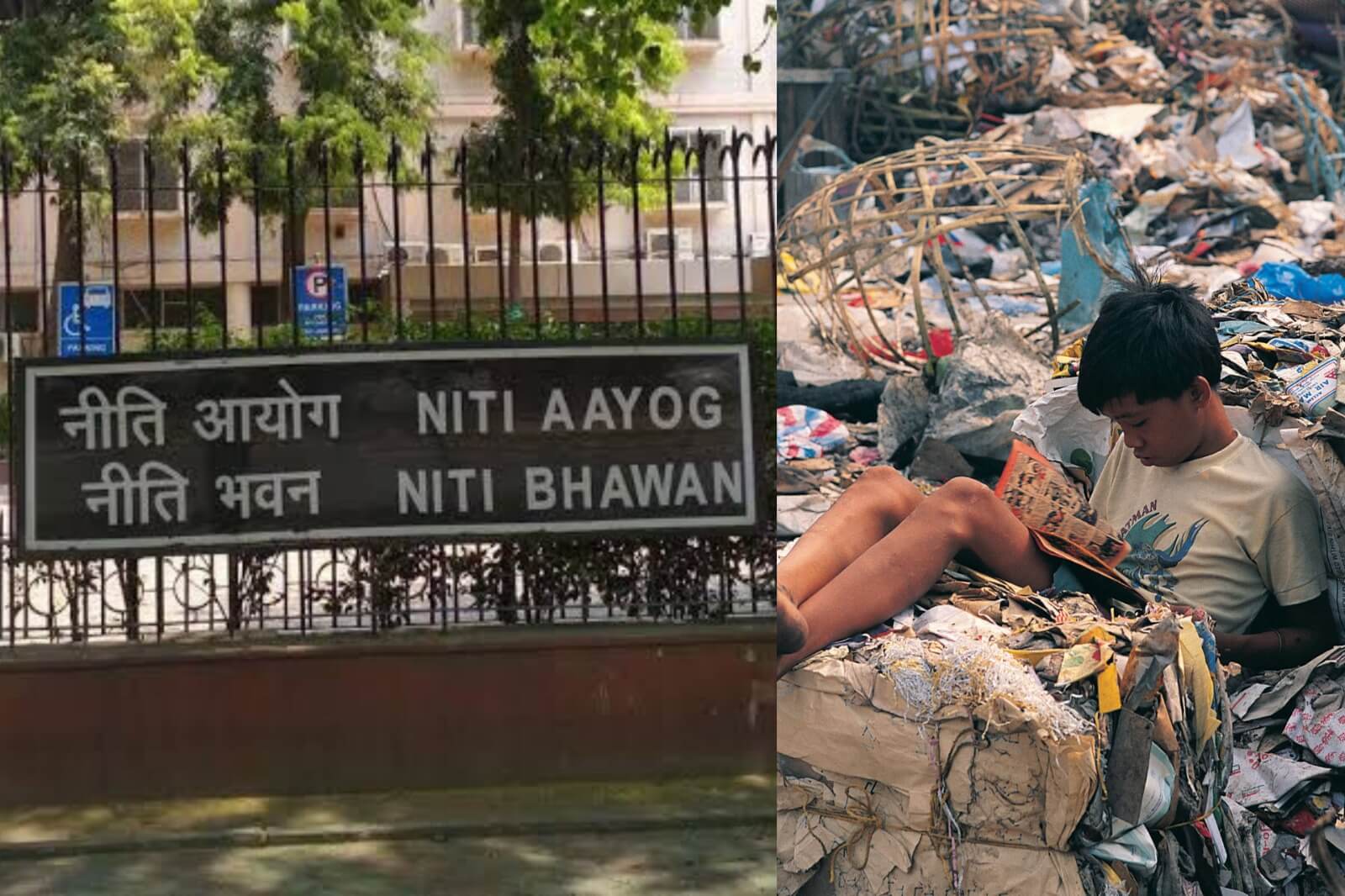
NITI Aayog reports that 24.8 crore people moved out of multidimensional poverty in India since 2013. The reports show a strong decline in multidimensional poverty of 17.89% of 29.17% in 2013 -2014. The government is trying to reduce this further to 1% significantly by all efforts being made in that direction. This article provides you with knowledge of poverty levels in India and government measures to reduce poverty in future.
Niti Aayog Report:
The reports from NITI Aayog claim around 24.8 crore people have been moved out of multidimensional poverty with Uttar Pradesh seeing a huge decline in poverty levels along with Bihar and Madhya Pradesh registering 2nd and 3rd place in the reports. In 2013 – 2014 the poverty level of the nation stood at 29.17% which later declined to 11.28% in 2022 – 2023.
The national multi-dimensional poverty is categorized into 3 equal dimensions health, education and standard of living. These are further divided into 12 development-aligned indicators such as nutrition, child and adolescent mortality, maternal health, school attendance, years of schooling, Sanitation, drinking water, cooking fuel, electricity, housing assets and bank accounts which account for the National Multidimensional poverty Index(NMPI) while Global(MPI) covers only 10 factors.
9 Year Development:
Uttar Pradesh topped the list with 5.94 crore people coming out of poverty followed by Bihar with 3.77 crore people and Madhya Pradesh with 2.75 crore people escaping the poverty. Nearly 2.75 crore people have come out of multidimensional poverty every year with a ratio of 10.66% per year between 2015 – 2021 which is very fast when compared with 7.69% every year between 2005 – 2015.
If the same decline continues in poverty levels it is said that India can reach the Sustainable Development Goals (SDG’s) value of 1.2 at one point in future with an estimation to reach half of it around 2030.
In the development of these 9 years from 2013 to 2022 cooking fuel and housing have seen the highest decline while child& adolescent mortality, electricity and bank accounts have seen the lowest decline.
Government Schemes To Fight Poverty:
Government Scheme List(Government initiatives) –
- Poshan Abhiyan
- Anemia Mukt Bharat
These schemes are supported in declining the levels of health issues by having access to the best healthcare schemes from the government. India has been providing the largest food grain distribution scheme to the selected beneficiaries that accounts for food security under the National Food Security Act(NFSA).
We can see the improvement in the decline of poverty only due to the implementation of government schemes that have improved the living standards of poor background families. Though there is a lack of data for 2005 – 2016 and after 2021 for headcount, the total poverty level is based on a compound growth rate of reduction in poverty levels during 2005 – 2016 and 2019 – 2021. It is said that the progress has been very significant through the government towards reducing the poverty levels by improving the standard of living of poor people.
Non-Mainstream Pooled Investment Report:
The report of National MPI was based on both the surveys of National Family Health Surveys 4 ( 2015 – 2016) and Survey 5 ( 2019 – 2021) while Oxford Policy and Human Development Initiative (OPHI) and United Nations Development Programme (UNDP) have provided technical inputs for overall estimations and provided data. World Bank defines International poverty lines by $2.15 daily to measure monetary value.
Conclusion:
The World Bank defined the headcount ratio as $2.15 per day which declined to 11.9% in 2021 from 18.73% in 2015 representing the data shown by the government is accurate. Regarding the decline in multidimensional poverty in the country the government is aiming to reduce it to less than a single-digit per cent (1%) in 2024. The faster decline in poverty levels is leading to reduced uncertainty issues and secure living.
FACT: The National Food Security Act is providing free food grains to 81.35 crore beneficiaries from both urban and rural regions.
Subscribe to our Newsletter for more!
All The Information Given Is Quoted From Niti Aayog Reports – NITI Aayog